Sunday, 29 March 2009

The Complete Richard Hannay

The first thing to say about John Buchan's Richard Hannay is that he is probably not the man you think you know; at least, if you are anything like me. My impression, formed from fragments of film adaptations and a deep suspicion of the traditional boys' adventure story (whatever that was) inculcated (probably) in earliest childhood, was of an English gentleman, an adventurer in the service of the British Empire, an insider. Richard Hannay is perhaps all these things; but he is not simply the sum of these qualities, and none of them are automatic.

Hannay is an outsider several times over. When introduced in The Thirty-Nine Steps he is in London because that's what men who have made their 'pile' out in the Empire do. He's a successful mining engineer spending his fortune gained in the mines of southern Africa. Although born in Scotland, Hannay has lived in Africa since boyhood, but feels that he has exhausted its possibilities. A life of renting rooms in London and drifting through clubland without introductions leaves him frustrated. His career as an engineer has made his fortune and it is the part of his past which he introduces to us first; but he has also been a soldier and emerges from the first book as someone who takes for granted that the Second Matabele War, in the post-imperial era more easily understood as a war of colonial subjugation and expropriation, was a conflict of moral improvement both for the victors and the defeated. After the success of The Thirty-Nine Steps (initially serialized in Blackwood's under a pseudonym) Buchan extended Hannay's world into one he was already developing in his other contemporary novels and short stories, and added a circle of characters including Sandy Arbuthnot, later Lord Clanroyden, a Scottish aristocrat, traveller in the east and master of disguise; John S. Blenkiron, an American engineer and millionaire investor who acts in the British interest during the Great War; Peter Pienaar, mentioned in The Thirty-Nine Steps as "the best scout I ever knew"; Mary Lamington, nineteen-year-old intelligence operative who takes Hannay by surprise in such a way that he marries her; Geordie Hamilton, patriotic brawling Scots soldier who becomes first Hannay's batman then a loyal retainer of Sandy's; and Scots laird and baronet, enthusiastic and skilled pilot, Sir Archie Roylance. All are the stronger for being relayed through Hannay; when in The Courts of the Morning (not included in the combined volume) Hannay chooses not to join Sandy and Blenkiron in their South American adventure, the bulk of the novel feels emptier for its third person narration.

Hannay's opinions and prejudices are continually foregrounded by Buchan; Hannay emerges as a character through the gap between the limited outlook expected by those seeking to manipulate him, and Hannay's own broader view. In The Thirty-Nine Steps, Scudder intrigues Hannay with his tale of Jewish conspiracy, but never entirely convinces him. His African experience is crucial. Later, in The Three Hostages, Dominick Medina entirely misreads Hannay's character, fatally for Medina's ambitions. Medina's roots in England are deeper than Hannay's, and though he is descended from Iberian exiles and is influenced by an Irish mother who holds England in disgust, it is his Englishness which is emphasised and which may lead him to consider Hannay dull and an ideal pawn. Much or most of the overseas experience with which Medina is widely credited turns out to be fraudulent, and what he has learned, he lacks the understanding to interpret beyond narrow self-interest. Frequently throughout the Hannay books, the reader is implicitly asked to contemplate how little those know of England who only England know.

The great charm of The Thirty-Nine Steps arises from its combination of travelogue and adventure story. For a substantial section of the book it appears that the events which leave Hannay a wanted man are a red herring to allow Buchan to present a series of vignettes depicting Scottish types. For Hannay Lowland Scotland is an ancestral home which he has never really known; though he returns to it in a series of crises, in The Thirty-Nine Steps, in Mr Standfast, in the second climax to The Three Hostages, and the Laverlaw section of The Island of Sheep. In The Thirty-Nine Steps Hannay finds an innocence in Scotland with which he is sometimes impatient - the audience for the radical candidate he finds deluded - but those who are happy with their traditional social roles are largely trustworthy and in some cases models of charity. Characters of this type appear in some form or other throughout the books. They are appropriate for a land which in Buchan's scheme for Hannay's world is a kind of Elysium, often disturbed from the outside, but which when properly maintained - as on Sandy Clanroyden's estate where Hannay and Haraldsen retreat in The Island of Sheep - can strengthen one against those who wish harm. However, to do the work one is called to do one has to leave the sanctuary of the Lowlands. England is the principal theatre of industry and the head office for the rest of the world. Disorder comes when that head office is subverted (as in The Thirty-Nine Steps) or loses sight of a clear aim (as in The Three Hostages).

The Hannay books aren't straightforwardly simplistic adventure stories either. The Thirty-Nine Steps was famously written while Buchan was confined to bed as an experiment in writing a 'shocker' - a "romance where the incidents defy the probabilities and march just inside the borders of the possible" (quoted Lownie, John Buchan, 119). There's something self-consciously genre-challenging about it - Scudder presents the plot to assassinate the Greek prime minister, Karolides, in terms of a conspiracy of cliches: anarchists, capitalists and especially Jews - but Hannay finds the truth more prosaic and more dangerous, a foreign power determined to provoke a European war at its own convenience and whose agents in Britain are long-established and skilled at hiding in plain sight within the Imperial establishment. This scenario is presented as a more realistic depiction of European power politics, helped by the anonymity of the German agents who if having something of the diabolical masterminds of pulp fiction about them seem less prone to caricature, and more threatening, because we never learn their names - at least, not in this book.

The Three Hostages
also draws attention to the artifices of the thriller. The character of Dr Greenslade recalls Scudder, and prompts in Hannay a discussion of the way a thriller is constructed; it seems a neat joke when we learn that following the Great War Hannay's secret service contact Sir Walter Bullivant is now Lord Artinswell, and thus in terms of his signature has moved from 'B' to 'A'. The confrontation across the wild landscape of Machray, while awkward in the context of the main narrative, is called for because Buchan, through the revulsion of Hannay, has built Dominick Medina into such a fiend (if one brought down by his own arrogance) that the convention of the exercise demands that Medina seek swift personal vengeance.

Both The Three Hostages and The Island of Sheep are disappointments after Mr Standfast, presented as the centrepiece of the Hannay novels in the five-book Penguin combined edition, and with some justification. Both it and the second instalment, Greenmantle, read like the work of a government propagandist, which they were; but there has been a decided shift in tone and content. Greenmantle, like The Thirty-Nine Steps, takes place in a world where women are distant and mysterious - Hilda von Einem is a threat to Hannay because he has little experience of women, and she almost destroys the world-travelled but ascetic Sandy Arbuthnot. The German commander, Von Stumm, plays up to the stereotype of the physically heavy, privately effeminate officer. The book fulfils the role of reminding its readers of the importance of the Ottoman Empire as a theatre of war, and the contribution of the Russians, whose commander at Erzerum turns out to be a Russian grand duke who had once hunted with Peter Pienaar in South Africa in 1898; the Russians are thus marked as familiar and knowable.

Mr Standfast was written at the close of the war, and while Greenmantle was set in a war where combat was still thought of in terms of cavalry charges, Mr Standfast was completed once the war was over, and shows how Hannay, who is largely having a good war, deals with the deleterious effects it has on the home and western fronts. For John Buchan, successful people are adaptable ones who find something to do in changed circumstances and excel through that adaptability; Peter Pienaar is such, having trained as a pilot at an advanced age and emerged as one of the best fighters in the air, only to be shot down over Germany and one leg ruined. He is later allowed to move to Switzerland which further marks him as a non-combatant; his turn of phrase has become more elliptical and philosophical. He is one of two Fisher King figures, the other being Lancelot Wake, the conscientious objector whom Hannay first meets among the pacifist colony in "the garden city of Biggleswick" (itself a mocking of over-idealistic town planning) and whom he again encounters on Skye, and who gradually earns from Hannay a slightly uncomprehending respect. Wake eventually joins Hannay and his party on the western front as a messenger, and is killed from a shrapnel wound to his groin. Hannay's self-satisfied consignment of Wake to perpetual virginity, after Hannay has won the hand of the teenage spy Mary Lamington, comes to signify his silent recognition of Wake's status as a Grail prince, though he does not know it. There is a contrast between the honest conflict of the men on the front line, and the corrupting nature of the world of espionage; Graf von Schwabing, the chameleon-like survivor of the Black Stone defeated by Hannay in The Thirty-Nine Steps, once captured, is not handed over to the authorities but instead offered the chance of redemption by taking his place on the front line alongside British and French troops, where the extreme circumstances would not allow him to reinvent himself one more and disappear. Redemption as a theme emerges through the books; Medina turns away from the possibility in The Three Hostages, but hard work and a morally uplifting goal transform Haraldsen and to some extent restore both Hannay and Lombard in The Island of Sheep.

Much as The Three Hostages and The Island of Sheep fail to live up to the promise of Mr Standfast, they do express an aimlessness felt in Britain and Europe after 1918 which affects certainties Hannay felt in the first two books. While Greenmantle treats the Turks and Arabs with cultural condescension, the Britain of the later novels has similar vulnerabilities to Buchan's portrayal of the Ottoman Empire; the Imperialist assumptions have been swept away; even the metropolitan territory is fragmented, with the independence of the Irish Free State, and new leisure activities have sprung up, incomprehensible to Hannay, as barriers of rank and race are eroded. While an adventurer who respects risk-takers - the 'sportsmen' of the earlier novels - Hannay also takes for granted heredity, that peoples and classes have distinct characters shaped across generations. The Island of Sheep sees Haraldsen's thirteen-year-old daughter Anna assuming a natural and unchallenged leadership over the people of the Norlands, over whom her maternal ancestors had exercised lordship for centuries. She is also female and in the later novels the married Hannay is obviously less familiar with women, though he does not know his wife well enough to realise that she will have her own plans independent of his instructions and look for the eponymous three hostages herself.

The Island of Sheep concerns a grudge from Hannay's youth in South Africa coming back to haunt him and his old comrade Lombard; it is perhaps the difficulty of finding things for Hannay plausibly to do in South America that excludes him from The Courts of the Morning. The Island of Sheep is concerned only tangentially with the politics of the 1930s, as Haraldsen's father's dream of a society invigorated by a return to Nordic values could be a comment upon Nazi Germany. It's a regret that Buchan didn't live to write a Hannay novel set in the Second World War - the transformations which that conflict would have wrought on Hannay (who, like his creator, might have moved from an Imperial to an internationalist perspective, and would probably be more sensitive about the casual use of derogatory nicknames for ethnic groups) and his friends would have been entertaining.

Wednesday, 25 March 2009

Press Gang - first thoughts

I've recently started watching Press Gang, the first television series written by Steven Moffat, which ran on ITV between 1989 and 1993. As I've written elsewhere, when the first series began the location was too close to home, as I'd just spent a year as one of the editors of a school newspaper initially affiliated with a local weekly. I would have loved the staffing levels and the collective enthusiasm displayed by Lynda Day's team.

Press Gang has a format built on shifting sands at the frontiers of the plausible, but which is kept alive by the cutting wit of Steven Moffat's writing and the energetic belief of the cast in what they are doing. Matt Kerr, an important character seen only occasionally, is a well-known journalist who has made the unexpected career move of moving to a local paper, where he spins off a weekly Junior Gazette produced by students from the local secondary school. The Junior Gazette's staff are initially extracted from the school's cleverest and most motivated pupils, but by the time the first edition approaches Matt Kerr is complaining that all the problem kids have been thrust in his direction too, such as Spike, American and therefore uninhibited by British reserve and also the perpetrator of an unmentionable act at the school disco. Dexter Fletcher's Spike becomes the romantic interest for Julia Sawalha's Lynda, however much she refuses to acknowledge it. The large workspace used by the Junior Gazette looked, plausibly, like an abandoned compositor's room; while early episodes of the first series look back to classic early twentieth-century depictions of the newsroom, where even the telephone is exotic (the Junior Gazette shouldn't have one, by agreement with Matt Kerr - an odd prohibition but the absence of the phone helps an episode or two along) later ones acknowledge the arrival of networked computers, as used by tetraplegic contributor Billy Homer.
Discovering Press Gang now is to look into as vanished a world as my long-ago late-1980s sixth form. ITV original children's production has long disappeared, and it's difficult to imagine the demographic-strangled CBBC commissioning this now. Too quirky for a Five commission, its entrenchment in the heightened reality of children's television makes Press Gang unlikely Channel Four material, post-Hollyoaks. The large cast alone dates it. There is an absence of toilet humour, but a sprinkling of cheery sexual innuendo every so often which marks Press Gang's attitude to growing up as an experience where enjoyment can be found amidst the anguish; unlike the by-the-numbers earnestness in what I've seen of Tracy Beaker or the hand-holding of The Sarah Jane Adventures, there is little need to heavily signpost the lessons learned by the characters.

As well as providing invaluable support for a young writer and a young cast to show how good they were, Press Gang is about teenagers coming to grips with adult responsibilities, and how the road to self-knowledge is a dangerous one, sometimes fatal. At eighteen or nineteen, I saw Lynda as repellently self-assured; two decades on, she seems very vulnerable. The self-assurance is a veneer, used for comic effect - as in her repeated insistence that she has no particular interest, romantic or otherwise, in Spike - and for tragic, such as her failure to realise how serious David Jefford's alienation actually is, prompting the harangue which leads to David's suicide in Monday-Tuesday. Lynda sustains it by her capacity for self-protecting tunnel vision, which propels the narrative of Breakfast at Czar's as she ignores the evidence which would confirm that the Junior Gazette has been misled by head of the council planning committee. How far her decision to shut the team in the office all night, so they can produce a new edition in a few hours, is consciously motivated by the fact it prevents Spike going on a date with the 'obvious' Charlotte is something Lynda could not and would not answer.

Lynda stands for integrity; opposite her is Colin, the Junior Gazette's head of sales and briefly (in Shouldn't I Be Taller?) her successor as editor. Colin's principal role is comedic - he is the class clown, his outfits get louder, and his schemes more grandiose across the season and a half. Where Lynda stresses the Junior Gazette as a responsible, campaigning 'Voice of Today's Youth', Colin learns the lessons of the red-tops and for one horrible issue has the team produce the sensationalist Gaz. A later episode has Colin build up his stooge Fraz into a chess prodigy so he can stage a chess match against local chess phenomenon Suzi Newton, played by Abigail Docherty whose general physical resemblance to teenage mathematician Ruth Lawrence, a semi-regular fixture in the media in the mid- to late-1980s, is exploited by her performance and her costuming.

The regular cast of Press Gang were all on cusps of careers at this point. Some had become established television faces as children, but would move away from regular exposure after Press Gang, like Mmoloki Christie or Kelda Holmes. Lee Ross and Charlie Creed-Miles are among those who have established solid working careers; Lucy Benjamin was in EastEnders for a while, Dexter Fletcher is rarely without period costume these days, and Gabrielle Anwar has emerged from Hollywood startletdom into leading roles on American television. Julia Sawalha is rarely off British television screens.

I'm currently a few episodes in to season two, and so have yet to see the Junior Gazette cut its ties with school and become a fully commercial enterprise in the later seasons. More when I have done so.

Sunday, 18 January 2009

Tony Hart 1925-2009

It's been a week where people who influenced the popular culture of the world in which I was born and grew up have been dying - 'head Dalek' John Scott Martin, Patrick McGoohan, Angela Morley (composer of the ATV logo music, and much, much else), John Mortimer, David Vine, Ricardo Montalban. Now, Tony Hart has gone. I first remember him as a largely silent presence on Vision On, where only presenter Pat Keysell spoke for any length of time and with her microphone turned on, and where Tony Hart was the most respectable-looking of the anarchic forces of communication which Pat kept under the barest level of control. Later on, there were Take Hart and Hartbeat - Smart Hart was after my time and I hadn't realised that it had existed, though I knew that Smart continued the BBC children's television art tradition, including the Gallery. His contribution to Blue Peter as designer of the ship logo is well-known, but he was a guest presenter in that programme's early years as well.

Tony Hart visited the Oxford Union in early 1991, and kept a packed debating chamber of students absolutely rapt. We were the end of the Vision On generation, the first to know Morph, and listened to tales of his move from the army into television graphics - "Every few mornings I wake up thinking 'You're an officer, man! Is this any way to spend your life?' " (Yes! his listeners cried telepathically) - with recollections of how nice a person Colin Bennett was to work with, and carefully making sure that Peter Lord and David Sproxton received credit and praise as creators of Morph, often misattributed to Hart, including by the BBC today until Hart's former producer Christopher Pilkington corrected them on air. At one point, before telling an anecdote with post-watershed content, he asked "Are there any children in the audience?" and of course we all laughed self-consciously, because when he was there we were children again. A great communicator, who will be missed.

Sunday, 7 December 2008

Quantum of Solace

I've never been to see a James Bond film in the cinema before, but grew up with them flickering in and out of my awareness on television. I think the first one I saw might have been You Only Live Twice, or perhaps Live and Let Die. I haven't seen Casino Royale either, so this was my introduction to Daniel Craig's Bond.

I was left with the impression that the Bond franchise is suffering an identity crisis, though there were signs that it is working on resolving it. I watched most of the Pierce Brosnan films on television, and while there is the superficial connection of M still being played by Judi Dench, otherwise this doesn't seem to be the universe that Brosnan's Bond inhabited. Where Brosnan's Bond fought larger-than-life megalomaniacs, Craig fights less tangible threats. The high technology now belongs to MI6 with their giant touch-sensitive display screens; the enemy in the field deals in the material world, water, oil, guns, bullets, blood and bone, and these need to be Bond's weapons too.

The audience is played with, of course. Gemma Arterton's Fields appears to be the unexpected introduction of a more traditional Bond girl, but she is a play-acting minor foreign office staffer, seduced by Bond almost before they meet, and she provides another layer for Bond's guilt. I don't know the books at all, but Olga Kurylenko's Camille, with her scarred back, echoed what I think of as a Fleming trope, the beautiful woman with the physical imperfection caused by a man when she was very young, though I don't know whether it occurs outside Dr No.

Saturday, 8 November 2008

Doctor Who: The Talons of Weng-Chiang. The state of opinion in 2001.

Time to bring out one of my old Doctor Who fanzine articles, lately rediscovered. This was published in Faze issue 23, in 2001.


Nearly five years since the last new Doctor Who production for television was broadcast, and eleven years since the last series, it's becoming more and more difficult to say anything new about the programme. Stories that through the 1990s, especially, were closely scrutinised, deconstructed, reconstructed and pastiched in Virgin or BBC novels are receding into the past. There's a danger that a critical consensus could emerge by default, as fandom's intellectual wing finds it has nothing more to chew and moves on, leaving newcomers with sets of statements that become final and definitive by neglect.


This situation affects 'classics' as much as it does the less-regarded adventures of the Doctor, and one of these is 'The Talons of Weng-Chiang', one of those stories that almost everyone still rates highly. It came second in the DWM awards in 1998, at 89.21%. In this article I intend to question some of the recently-printed statements about Talons, and try to reanimate the spirit of debate!


"It's pulp adventure, and not profound - there's no message, no clunking allegory to be found at its core..." Alan Barnes, DWM 295, 3 June 1998


It's certainly pulp adventure, and I wouldn't claim that it sets out to moralise, but like all good drama, 'The Talons of Weng-Chiang' is concerned with the relationships between people and how individuals live with the compromises that they make in everyday life. In doing so it delves a little further than most Doctor Who stories do. 'Talons' concentrates on physical appearance and how this affects how people see each other as human beings. The viewer is alerted to this by the Doctor's failure to recognise what marks out the features of Li H'sen Chang from those of the police sergeant in episode one, ethnicity being all-important to the Doctor's Victorian British hosts. The first exchange between Jago and Litefoot is also remarkable as Jago comments that he should have recognised Litefoot's intellectual ability from his physiognomy - a fashionable notion throughout the nineteenth century, allied to the skull-exploring science of phrenology, with deeply obstructive effects for those deemed, 'scientifically', to be physically second-rate.


The story plays with Victorian theory - and modern prejudice - by presenting the central villain as a man in a mask, who has become deformed through his own experiments and is failing to restore his physical form. His speeches often are self-congratulatory, but Magnus Greel cannot bear to look at his own face, nor does he wish anyone else to see it. It is almost as if Greel's experiment has revealed his own inner nature. The Zygma experiment is another picture of Dorian Gray, but Greel has become his own canvas.


"Goofs: Why does Greel need girls rather than young people in general?" Paul Cornell, Martin Day and Keith Topping, Doctor Who: The Discontinuity Guide, 1995


The most obvious explanation for Greel's obsession with young women is a sexual one; his draining of their life essence analogous to the way that Dracula (indirectly alluded to both in the script's dialogue and its execution - Greel seems most active during the hours of darkness) principally sought young women as his prey, or to the sexual assaults of 'Jolly Jack', mentioned by Casey as part of the scene-setting in the first episode.  Alternatively, as the script suggests that his DNA is breaking down following his failure to enter the correct levels before making his journey through the zygma beam; perhaps all the damage was to his X chromosome, and he can only be guaranteed repair by taking genetic information from young women, unravelling their bodies as he does so. This is probably bad pseudo-science, but it should not obscure the fact that Greel is as foul a rapist as the Ripper from whom he is drawn.


The difference between Greel and the Ripper is that he needs a procurer, someone who will drag his victims from the streets, and his participation in this business shows how far Li H'sen Chang is prepared to go in the service of his benefactor. Chang shows occasional signs of wanting independence from Greel. John Bennett rolls his eyes in exasperation as Greel outlines his demands during their scenes together in the carriage, and we learn just before Chang's death that he was anticipating a performance before Queen Victoria. The logic of Chang's ongoing season at Jago's establishment is that he remains there to protect Greel; how many times, one wonders, has he had to hypnotise Jago to keep him from becoming suspicious? Yet in other scenes Chang appears to be genuinely subservient to his master; it's difficult to be certain whether the production had a clear line on how far Chang is independent of Greel. The focus of the story, after all, is first on the disappearances, and then on the who and what of Weng-Chiang, not on the detail of the criminal network that Chang runs to service Greel's needs. As a beaten Chang escapes the Doctor to offer himself as a dinner guest of the giant rats, with himself as the entrée, the Doctor muses that 'it was a good act'. This simple, but multi-layered sentence, refers not only to Chang's stage performance, but to his benevolence in taking in the failing Greel in the first place, and perhaps also pays tribute to his ability to convince Greel that he was his devoted servant for so long, well after his experiences had taught him that Greel was not the god he had once appeared. Terrance Dicks, perhaps feeling that he would be unable to explain this ambiguity to the Target audience, omitted this line from the novelisation and portrayed Chang as a religious fanatic at the (almost) last; a pity, as the part is written and portrayed with more sensitivity, and Dicks's novelisations had a great influence on the way that fans remembered the broadcast serials.


"Even as late as 1977's 'The Talons of Weng-Chiang', a white actor was employed to play a Chinese villain under heavy eye make-up. Strangely, many fans of this popular serial are surprised that it hasn't had a recent terrestrial repeat." Gary Gillatt, Doctor Who From A to Z, 1998


Having cited Terrance Dicks's approach to the novelisations as one reason why the sophistication of Chang's characterisation has been overlooked, I'll now quote Dicks again to explain the racist casting puzzle which has dogged 'Talons' ever since it was broadcast. I remember reading in the article 'Overseas Overview' in DWM late in 1982 of how the Canadian broadcaster TV Ontario ended up not showing 'Talons' in their province at all following concern from representatives of the Chinese community. David Howe and Stephen James Walker write in Doctor Who: The Television Companion that Bennett's "performance and make-up are so convincing that it is difficult to believe that he is not actually Chinese". Bennett's performance is strong, yes, but his features can't be disguised by prosthetic eyelids, and the result could even be seen as grotesque.


It's possible, though, that this effect was sought by the production team. To quote Terrance's interpretation of the story again:

"...the magician had appeared from nowhere. Perhaps he really was from China as he claimed. After all he really was Chinese, unlike most Oriental magicians who were usually English enough once the make-up was off." Terrance Dicks, Doctor Who and the Talons of Weng-Chiang, 1977

Most commentators have agreed that the success of 'The Talons of Weng-Chiang' stems from its sense of fictional period; the Doctor and Leela do not step out of the TARDIS into Victorian London as such, but in a particular Victorian London that was already well-established in the popular imagination. I don't know about the contributions of Sherlock Holmes, Sexton Blake or Fu Manchu to Talons, but those who do agree that their influence is all there. It's appropriate therefore that instead of facing a villain who appears to be a native of China, the Doctor has as his foe someone whose image evokes a late-nineteenth-century idea of how a hostile, "inscrutable" Chinaman might look - a European in exaggerated eye make-up and elaborate moustache. This argument does not refute the charge of racism but shows how the casting of John Bennett was a calculated manoeuvre rather than an act of laziness on the part of a production team reluctant to give a leading role to a non-white actor. 

I've dealt with the main criticisms that I can remember, and my remaining observations are somewhat random. London's geography in 'Talons' owes little to reality; there is no doubt that the Fleet runs near Limehouse in the televised story, whereas in reality it enters the Thames under Blackfriars Bridge, having followed the course of New Bridge Street, Farringdon Street and Farringdon Road. A friend of mine once insisted that I had assured him the Venerable Bede really did like fish, although I have no recollection of anything of the sort. Does anyone know if Bede mentions a taste for seafood in his writings? Counterfactualists might like to speculate on the companion we might have had, if Leela had not been carried over from 'The Face of Evil', as the Victorian setting would have been the obvious point to introduce Philip Hinchcliffe's Eliza Doolittle character, although this story shows very well how Leela ended up fulfilling that role. I'm an admirer of Jago and Litefoot as characters in the context of this story, but have difficulty seeing how their partnership would have continued in any proposed series. Their characters would have needed to be fleshed out considerably, and at the very least Litefoot would have needed to find a laboratory without masking tape on the walls! I mean to get round to digging out the magazine he is seen reading at one point, issue 917 of Blackwood's Edinburgh Magazine; considering the care taken with the Doctor Who of this period the choice of periodical could well have been deliberate. Finally, after a couple of viewings of the story with frenzied note-taking, I'm realising how much easier DVDs will make the reviewing process!

Thursday, 16 October 2008

Life on Air, by David Hendy

I first posted a version of this review elsewhere earlier this year, but the recent paperback publication of David Hendy’s Life on Air seems a good opportunity to revisit it. Life on Air was a deserved winner of the Longman-History Today prize as 2008 Book of the Year.

Life on Air is perhaps best described as an institutional history; but the limits and nature of the institution the reader might be presupposing are immediately called into question. The title and the subject court the reader's experience as listener to a Radio Four whose identity which is validated by continuity in the content and personality of the service. As David Hendy reminds his readers, while Radio Four has always had a controller and its own staff, the character of the station, like other BBC services in what was once called sound, then radio, and now audio (the recent rechristening of BBC Radio 7 notwithstanding), has concurrently been dependent not only on the general direction of BBC radio as set by successive directors or managing directors, but also in part on the ambitions of other departments within BBC radio. Each of these (particularly before the move to corporate centralism in BBC management under John Birt) existed to a large (if variable) extent on its own terms and championed its own interpretation of what public service broadcasting ought to be in Britain, how the BBC should fulfil its role, and fought for its own share of the carefully rationed wavelengths. The evolution of Radio Four took place within this context.

The emergence of Radio Four's present character is almost a story of how people in lower, middle and lower senior management in BBC radio championed 'the rich mix' - a term which Hendy associates with one particular fight in defence of Radio Four, between 1978 and 1982 - against various committees and several managing directors of radio, directors-general, or governors, against expectations that in the near future 'the rich mix' would be redundant and that Radio Four's purpose would be 'informational'. Not only was the cause of rolling immediacy particularly demanded by journalists, it seems also to have been an expectation of Ian Trethowan, managing director of BBC Radio from 1970 to 1976, that Radio Four was to become a news and current affairs network; and many other figures in the BBC took this for granted at various points between 1967 and the early 1990s.

Hendy starts the book with a chapter '30 September 1967', and David Dunhill's elegy for the Home Service as he closed it down for the last time (though missing my favourite part of that announcement, the punning "What is radio for?"). While Dunhill assured listeners that the Home Service was like a bride on the eve of her wedding, which would go on being the same person - "we hope" - the change of name to Radio Four came as part of an ongoing process of rethinking the purpose of the Home Service which had been going on since the arrival of Frank Gillard as director of BBC Radio in 1963. At this point the Home Service was in the middle of a conscious transformation, having over the previous three years been gradually exchanging music programmes with the Light or Third programmes for speech. These included taking over The Archers from the Light, and sending programmes like Record Review to the 'Music Programme' that shared the Third's frequency, though it was the sharpening of the music-led networks that was BBC radio's priority, and thinking about the future of speech was an afterthought. This reshaping did not end in 1967; Woman's Hour, for example, didn't come to Radio Four from Radio Two until 1973. Its most successful controllers seem to have been those who tenaciously defended the character of the network while stressing evolutionary change.

For someone for whom BBC radio has been a recurrent soundtrack to his life, there are smiles of familiarity as various landmarks are passed. In October 1970 new controller Tony Whitby - husband of children's television's Joy Whitby, creator of Play School - merged four consumer programmes into You and Yours, listened to in my lunchtimes at home in the early 1980s, and still thriving in the twenty-first century. Brian Redhead arrived at Today in 1975 as one of many attempts to harden its news content. This drive was frustrated briefly during the 'counter revolution' of 1977 led by controller Ian McIntyre, which saw Today being sliced in two to allow for Up to the Hour, a medley including paper reviews, Thought for the Day, and clips from comedy records, the intention being to make the news more focused; the experiment was ultimately as good as denounced on air by announcer Peter Donaldson when he urged listeners to retune to other BBC networks rather than listen to it.

Many of Radio Four's crises seem to have arisen from anxiety that its plural personality couldn't be maintained, or from the certainty of factions such as the aforementioned news lobby that it could not and should not be sustained. Hendy does not stray too far into the debate on modern Britain's uneasy and uncertain grasp on what 'class' is, which continues to shape current discussion about Radio Four. (I wasn't sure if the recent utterances by Jane Garvey about the ‘middle class’ nature of the station, following her translation from Radio Five Live to Radio Four and Woman's Hour, were self-conscious PR, or an unthinking condemnation of the debate about what constitutes intelligent discussion and what constitutes elitism to another round of dubious class-based rhetoric.)

Even as Radio Four 'Basic' took over 1500m/200kHz long wave and became Radio Four UK, complete with Fritz Spiegl's famous theme, on 23 November 1978, it was being undermined from within. The “new national service from the BBC”, as it was hailed by announcer David Symonds, was rapidly being presented at a succession of meetings as an anachronism. The election of Margaret Thatcher’s Conservative government in 1979 encouraged those in the BBC who thought a period of retrenchment, even retreat, from the goals established at the start of the 1970s was inevitable. For a while it seems to have been assumed that the numbered stations of 1967 would be phased out and that most of Radio Four's output would be merged with local radio under the heading 'BBC Town and Country Radio' or possibly 'BBC Radio England', acknowledging that for many the requirement to carry parliamentary coverage on long wave, and the absence of VHF frequencies for Radio Four outside England (not fixed until the 1990s) meant that 'Radio Four UK' had failed at its inception. Later, John Birt, an outsider from ITV parachuted into the BBC as its first director of news and current affairs, for reasons which had a lot to do with politics, was incensed in 1987 when Radio Four allowed Today to end at 9am on the day of the Great Storm; controller Michael Green reasonably said that there was no point keeping news on air as local radio was best placed to provide information to those affected and the storm hadn't made much impact anywhere north of Watford. The incident helped fuel Birt's desire that Radio Four should become news-led or evolve into or spin off a serious news network, something that never happened in the way Birt imagined, except during the 1991 Gulf War and the attempted coup in the USSR later that year.

Hendy celebrates but also criticises the atmosphere described by some as 'creative inactivity' which allowed producers to spend time thinking; against the neo-managerialism of 'Producer Choice', introduced by Birt as director-general, and which was in full flight in 1997 when Hendy ends the main body of his account, he places the introduction of time management, a fuller appreciation of costing and editorial monitoring in the 1960s which decisively ended a culture where many programme-makers spent long lunchbreaks in the pub. Birt's BBC awaits its historian, though Hendy briefly introduces business sociologist Richard Sennett and his conclusions about the conditions which ensure quality of output without ruling whether or not Birt's reforms decisively affected this at Radio Four for better or worse.

By good fortune as much as by design, it seems, Radio Four has moved from its roots in the 'middlebrow' Home Service, born out of the need to comfort and sustain Britain at the dawn of the Second World War, through the incorporation of some of the high cultural aspirations following the dissolution of the old Third Programme during the 1960s (which magnified in importance following the arrival of Melvyn Bragg as presenter of Start the Week in 1987), into an age when we can no longer be certain what low and high culture are. Its role now, Hendy thinks, is "to widen out horizons a little as the world of fragmenting tastes and ideologies pulls us apart". This is a development unforeseen by the "public affairs" lobby who wanted drama and comedy excised from Radio Four in the 1970s, and perhaps also by John Birt, who apparently expressed bafflement at Michael Green's determination to hold on to Today, The World at One and PM, which (in the discussions which eventually led to the creation of Radio Five Live) Birt wanted as the core of his desired 'upmarket' rolling news network. Didn't he want to lose Today, he was asked, so he could run comedy in the mornings? The 'rich mix' is surely richer for being mixed together on one network. The arguments used by European listeners during the 'Save Radio Four Long Wave' campaign of the early 1990s included that Radio Four was a good ambassador for British cultural values. The continued existence of Radio Four argues well for the health of British pluralism, whatever one's opinions of the state.

Monday, 13 October 2008

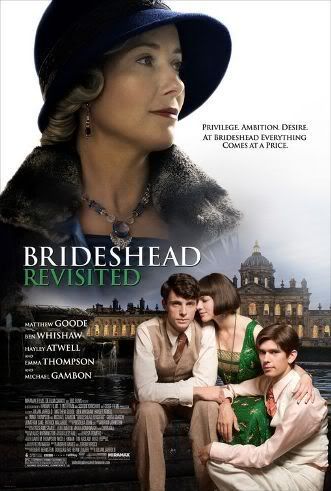
Brideshead Revisited


If the youth of a large proportion of the audience at Brideshead Revisited at the Odeon Magdalen Street, Oxford, last Thursday night was anything to go by, Brideshead Revisited retains its hold on the imaginations of new Oxford undergraduates. In fact, most of the people on the streets that evening seemed to be freshers, crowding around the entrance to Po Na Na, striding down St Giles with varying levels of conviction and purpose. This, perhaps, was their night; but if they sought the Oxford of today in Brideshead Revisited, they would have been hard pushed to find it.

I mainly know Brideshead Revisited from Granada Television's interpretation nearly thirty years ago. When I went to an open day at the college I eventually attended, I was told by one of the JCR that Brideshead had been a cult in 1980s Oxford, to the extent that 'to Brideshead' was allegedly a verb, referring to people who carried teddy bears around with them and aped the supposed manners of the 1920s. The reality of this exaggeration by the turn of the 1990s, as far as I saw, was a short-lived student society called the Romantics, active about the time of my finals. Nevertheless, there was a moment of personal recognition in this film; there's a moment in the book where Charles Ryder recognises the arrival of Sebastian in his life as the opening of a door in a wall into an enchanted garden, and Sebastian's room in Christ Church seems to have been translated from Meadow Buildings to a familiar staircase in Tom Quad, though I make no claim for that particular student society whose then-president reigned from a set there to have brought me within reach of grace.

The film, from a screenplay by Andrew Davies and Jeremy Brock, inevitably comes across as a précis of the book or (if you are like me) the longer television adaptation. Despite the protests of director Julian Jefford that he has never seen the Granada version, members of his crew probably have. The new film is haunted by the television series, with various performances echoing their television predecessors. Castle Howard is used again for Brideshead (abandoning a plan to use Chatsworth), and some of the scenes seem almost like alternate angle shots, as the same staircases and corridors used by Charles Sturridge are chosen again.

A lot of effort is put into incorporating details from the book here and there. Sebastian greets Charles on his first visit to Brideshead wearing pillar-box red pyjamas. There's some dialogue reconstruction in the early Oxford scenes, though Lunt the porter is only introduced to make the point that Oxford undergraduates did not 'do for themselves'; and there is nothing of the complaints about the women attending the ball. Cousin Jasper's denunication of Anglo-Catholics as "Sodomites" is however transferred to our first glimpse of Anthony Blanche's set on the river, one of many translations to celluloid (though there were several artefacts on the 'print' I saw which were distinctly electronic) which observes the letter but not the spirit of the book.

Advance publicity drew attention to the replacement of Charles Ryder's fascination with the Flyte family with a more conventional love triangle between Sebastian, Charles and Julia. Ben Whishaw's Sebastian is more fragile than Anthony Andrews's, though one of the failings of this increasingly staccato interpretation is that his decline seems all too rapid, and is sparked by the acceleration of Charles's love affair with Julia. In the book this begins on ship, in mid-Atlantic, a decade after Charles's friendship with Sebastian has ended; here, Julia comes to Venice with Sebastian and Charles, leading to a precipitate first kiss in a contrived carnival scene. The film has a less sophisticated understanding of sexuality than either the book or the Granada adaptation, and Sebastian seems far more motivated by the thwarting of his homosexual desires (here dealt with more explicitly than in the novel, though still tamely) than one feels he should. His final appearance in the narrative sees him in Morocco, a hybrid of ascetic holy man and AIDS patient, attended to by (and, we hear, later attending) bearded monks straight out of Renaissance painting.

Charles Ryder is played competently and often with subtlety by Matthew Goode, though he is working with debased material compared to Jeremy Irons. (Television folklore holds that although the Granada Brideshead was credited to John Mortimer, m'learned scriptwriter's work was abandoned at an early stage and largely used as a guide to scouting locations, with directors and cast improvising dialogue scene by scene based on the text of Waugh's book.) Problematically, Charles's longings here are far more material than they seem in the book; it's much easier to think at an early stage that he consciously longs to possess Brideshead with Julia, as Rex Mottram believes, particularly as here his involvement with Brideshead and the Flyte family is broken into three concentrated periods.

Davies and Brock, director Julian Jarrold, and their colleagues, impose a simplified and misunderstood version of the British class system on the film - and don't seem to realise that mentioning the word 'Catholic' at every opportunity, and as good as crash-zooming on rosary beads as Nanny Hawkins drops them, is no substitute for theology. Lord Brideshead, Sebastian's older brother, is turned into a hunting-shooting-fishing cliché rather than the unworldly and often ineffectual figure he seemed on television, and who apparently once aspired to the priesthood. Charles is a scion of a landed gentry family in the book, but there is no room for subtle gradations of social distinction here. The poor fellow is on an allowance less than a fifth of what he enjoys in the book; the aesthetic and spiritual wholeness he craves from Brideshead and the Flytes is trivialised. The character of Hooper in the book is a fellow-officer of Charles, though from an educational background that (in Charles's view) disregards the heroic and aspiration for something greater than the human world, in favour of a narrative of revolution-from-below. In the film he becomes a corporal, losing Waugh's points that the aristocratic culture of the Flytes had as good as been swept away before the start of the Second World War, and that without the heroic there was no hope of understanding the 'fairy-tale' of religion which revealed the spiritual universe hidden behind the curtain of the material world.

I tend to have a negative reading of the family dynamics within the Flyte family, and had seen their Catholicism as a symbol of their decline, acknowledging that this sat oddly with Waugh's own Catholicism; but it was explained to me after watching the film that I had probably missed Waugh's message that the Flytes can't reconcile being English aristocrats with being Catholic, both being different kinds of 'other' in early twentieth-century Britain. Having since finished the book I see that this is probably the case, but one wouldn't know it from the film. The story goes that Andrew Davies left the project because he wanted to make God the villain of the film, but if so it's still possible to discern his influence. The mania on the faces of the Flytes as the dying Lord Marchmain very determinedly crosses himself could be read by a sceptic as a possession by falsehood, while the conclusion of film doesn't seem very bothered with the state of Charles's faith, instead letting him snuff out his obsession with the Flytes in the chapel as if he was reconciling himself to the impending reign of the working men symbolised by Corporal Hooper.

So, this isn't Waugh, more off-the-shelf modernism; but it looks well enough and there are some striking images. Hayley Attwell as Julia photographs well, is well-draped, and goes nicely mad towards the end; Emma Thompson generally conveys the seriousness of Lady Marchmain's faith and her leadership of her family with attention, though I did wonder whether there were any better takes of her collapse at the Ryders' house, as this seemed overdone. Michael Gambon's Lord Marchmain is a more dangerous and effervescent performance than Laurence Olivier provided for Granada, and captured in more concentrated form the impression of Marchmain that Charles Ryder gradually builds up in the book. Nonetheless, this is a Brideshead made easy. While the new plot elements and the more conventional historical theme work, they flatten the story. Perhaps the affirmation of modernity I see in the final scene is more fitting for the clubbing, street-partying students of last Thursday night; but I'd still direct people to the DVD of the Granada series if they want a screen adaptation which does more justice to the novel.