Tuesday, 11 February 2014

Dramatic Spaces at the BFI: Let's Murder Vivaldi (1968) and Miss Julie (1965)

Since I last wrote about employment I've become a full-time staff member of an historical research project again; but earlier today I left early eighteenth-century bishops behind at my Bloomsbury office, and travelled to the South Bank and 1960s by bus, to see a couple of 1960s television plays in the BFI's Dramatic Spaces season, which ties in with the recent AHRC-funded project Spaces of Television, based at the University of Reading. The two plays were Let's Murder Vivaldi by David Mercer (1968) and Miss Julie (1965) by August Strindberg, translated by Elizabeth Sprigge. Both plays were directed (and in the case of Miss Julie adapted) by Alan Bridges, who died in December. There's an accessibly educated and informed post about the choice of these plays on the Spaces of Television blog, which also confirms the suspicion I had that at least one had suffered cuts at some point. Miss Julie suffers from the abrupt realisation of a sex scene which seems an all-too-brief excursion into the surreal, but was intended to be much longer and better integrated into the play as a whole.

Let's Murder Vivaldi was up first, perhaps because it was part of the most well-known strand of the single television play on the BBC, The Wednesday Play, or because it contained the most familiar faces among its cast, with Glenda Jackson as young civil servant Julie, and Denholm Elliot as her boss, Gerald, with whom, at the start of the play, she is on the verge of an affair. Paul Sumner as Ben, Julie's draughtsman lover, a frustrated violinist, was perhaps the weakest link in the cast, but Gwen Watford was calmly authoritative, patronising, manipulative but honest as Gerald's wife Monica. The play is one of those where the characters' dialogue comes across as shared inner monologue, but is of interest when what is revealed is an emptiness. The play even has a touch of horror-comedy in what its knife fixation builds up to - the slicing of Julie's face by the misarticulate Ben is in part misdirection. In the end, those who learn to accept their 'peculiarities' and stop trying to conform to other people's ideas of what they should be are the happiest. Denholm Elliot is a uniquely soluble actor, often looking as if he has consumed gallons of water and is having trouble keeping which is perhaps appropriate given one of Julie's 'peculiarities', which also works as a comment on television censorship. It's a powerful piece of 1960s rage against sexual, social and workplace conformity, though noticeably the voice of a simpler time.

Miss Julie - produced for BBC2's Theatre 625 strand - was a contrast in that it included some sequences filmed on location rather than being entirely in studio. Where Let's Murder Vivaldi is a series of two-handers (Ben/Julie, Monica/Gerald, Gerald/Julie, Monica/Gerald, Ben/Julie), the 1965 Miss Julie is a play with three speaking characters and in this version several non-speaking ones, all appearing on film. Bridges's Miss Julie reminded me of another television play of this era, Philip Savile's version of Huis Clos, with its largely location-filmed scene-setting. The use of a foreign-accented Gunnel Lindblom as Julie alongside a very English Ian Hendry as Jean and Stephanie Bidmead as Christine seemed odd at first, but perhaps it works as an indicator of class divisions, Jean and Christine being presented as audience identification figures while Julie is exotic and remote. Expectations are teased and confounded several times as sex brings complication rather than a gateway to permanent happiness and class and gender confine by education and expectation. It's mostly Hendry's and Bidmead's play, though, Hendry showing a range as Jean works through his many facets, and Stephanie Bidmead looks on, quietly confident that Christine is one of God's elect.

The BFI notes suggested that camera and performance in Let's Murder Vivaldi turned rooms into cells; this is too blatant an analogy for the way the play used the television camera, often stalking character by character, portrait shot by portrait shot, perhaps suggesting the characters are prisoners of their preconceptions. There are many ways out, all the same - characters go through doors in bedsitland or country hotels, or negotiate fashionable partitions. Gerald chooses to actualise his imprisonment, but blames only one of his jailers; for Julie and Ben, it's a question of coming to terms with who they are, not what they ought to be.

An Alan Bridges camera script must have kept the camera operators of Television Centre going up and down on their platforms. The many changes of tight angle in Let's Murder Vivaldi were noticeable, providing a fluidity which emphasised the brittleness of the harsh alternation of conversation partners in the penultimate Monica/Gerald scene. Miss Julie used yet lower angles on a staircase set, suggestive of moral hazard as well as the space's geographical location; but compared to Let's Murder Vivaldi and its parallel use of the domestic, especially the kitchen, Miss Julie's set and the way it was captured were more suggestive of space, and so perhaps of choices which could be made in the world outside Julie's father's estate, but in the end were not.

Wednesday, 20 November 2013

Danger UXB, part two

Continued from part one
 
Danger UXB negotiates two production house styles. The early successes of Euston Films could be characterised as concentrating on the underbelly of society: criminals and the police who pursued them with dubious methods. In contrast John Hawkesworth, co-creator, producer and lead writer of Danger UXB, was conservative by reputation and just as interested in the upper echelons of stratified British society as the lower ones. This was seen in his previous series Upstairs Downstairs for LWT and The Duchess of Duke Street for the BBC. This formula didn't preclude social mobility, with dramatic tension being extracted from cross-class liaisons and the accumulation of wealth and status by outsiders. 

Danger UXB is something of a barracks Upstairs Downstairs, with its cross-cutting between barrack room and officers' mess. The series' low-intensity character arcs, burning fiercely in a climactic episode, recall Upstairs Downstairs too. That concerning the brittle insecurity of Major/Captain 'Fanny' Francis is perhaps the most successful. It casts, possibly somewhat against type, Kenneth Farrington then best known to audiences for a long on-off stint in Coronation Street, and more recently a regular in Emmerdale. Francis's obsession with discipline is the barely disguised sadism of a self-hating man and his enthusiasm for reviving pre-war regimental mess dinners a sign of his retreat from the realities of the world as well as his hatred of Ash, transferred from the officer whom Francis blames for the end of his marriage. It's not the wisdom of the hierarchy which resolves the crisis, but Ash pulling strings through Susan's father Dr Gillespie. The episode displays a respect for human beings but a cynicism towards the ability of established structures and those educated through them to manage the ongoing crisis, a sentiment as appropriate to Britain in 1979 as in 1941. 

Another more specific borrowing from Upstairs Downstairs is the presence of nightclub and music hall sequences in occasional episodes. There was little room for niche television in the three-channel era, when programmes had to build a broad audiences. Consequently there's singing and dancing from Micky and her colleagues in 'The Silver Lining' and 'Butterfly Winter'. A further indication is the appearance of variety artiste Sapper Binns, played by real-life variety artiste Bryan Burdon in 'Butterfly Winter' and 'The Pier', which seem to have been made as part of the same block. 'Butterfly Winter' just happens to include a sequence filmed presumably in Chipping Norton Theatre (given where the relevant exteriors are shot) where Burdon/Binns can do his act. Not only is the sequence nostalgic for an audience which could remember pre-television variety, it draws on Burdon's own pedigree, his father being Albert Burdon, a star of music hall most associated (I learn from Louis Barfe's Turned Out Nice Again) with the slosh-spreading wallpapering routine. Binns's stagecraft, specifically his knowledge of theatrical mechanics, is presented as an asset to the company and he becomes, perhaps, Hawkesworth's tribute to the multi-skilled theatrical turns of his early career.

Binns only appears in two episodes, both directed by Douglas Camfield and presumably made as one block. The disappearance and reintroduction of regular characters without explanation was part of the reality of television production at the time, but is used to give an impression of the realities of war service and wartime lives, as people are transferred in and out of the unit with little notice, or husbands are unexpectedly invalided back to otherwise-entangled wives. It also helps suggest the passage of time. As in Upstairs Downstairs, the series had an internal chronology mapped onto the historical chronology of the period covered, but was not presented so rigidly that it could not be retroactively revised should a second series have been commissioned. 

The series was launched in ITV's listings magazine, TV Times, with features concentrating on the experiences of the real bomb disposal squads of nearly forty years before. Danger UXB was promoted as a drama with a public service mission, restoring an obscured part of the war to public memory. This complemented one of the themes of the early episodes, the early publicity given to the skills of the anti-explosive squads in the press, which gave way to silence when it was realised that the increasingly complex charges were designed with the intention of killing trained personnel. The first TV Times article provided a diagram of a typical excavation shaft and images of several types of wartime German bomb, accompanied by lurid headlines such as 'Your guide to a deadly war game' and 'Rain of death that fell on Britain'. The second article, 'The men who had only 10 weeks to live' was accompanied by a photograph showing Anthony Andrews in the company of four real-life bomb disposal men and related some of their experiences, in some cases pointing out that these tales would be fictionalised for Danger UXB. Coverage for the rest of the series was restricted to the occasional photograph on the listings page, aggravated by the end of the run by a printing strike which led to TV Times being published in an abbreviated form with fewer credits.

Press reaction to Danger UXB seems to have been cautious. Nancy Banks-Smith in The Guardian (9 January 1979) thought it "not... an important series" fixed on "nostalgia and noise". Banks-Smith did however note the appeal of Anthony Andrews as a leading man, "one of those golden lads with sensitive mouths", and the Daily Mirror also remarked upon Andrews's emergence as part of a new trend in male lead towards "The new, gentle man", contrasting him with the "aggressive virility" of Martin Shaw and Lewis Collins in The Professionals and likening Andrews to Patrick Ryecart of My Son, My Son (21 May 1979). Andrews continued to be raised by Mirror writers as a point of comparison with later male leads that year, such as the "mean, powerful and ruthless" John Duttine in The Mallens (who was careful to emphasise that in real life he vacuumed the carpet and helped with the cooking) (31 July 1979). The Mirror's coverage also promoted Danger UXB's public service credentials, not only through a profile of John Hawkesworth as 'TV's Past Master' (5 February 1979) but reporting how the episode 'Butterfly Winter' had led a Brighton man to realise he had put a butterfly bomb in his daughter's toy cupboard. (15 March 1979). This followed the defusing of another butterfly bomb in a bedroom in Rainham in Kent (The Guardian, 14 March 1979).

With a large cast, high production values - with at least one explosion required a week - the assumption that Danger UXB was too expensive for ITV to recommission has a ring of truth. Though dismissed as a "potboiler" by one television historian, the juxtapostion of lectures on bomb engineering every few episodes with the continuing rollercoaster love lives of the male protagonists, together with a sense that the series is consciously revising the collective memory of the Second World War in Britain, encourages curiosity. Anecdotal evidence suggests that there was at some stage thought of a second series, and there was even a Danger UXB annual published later in 1979. However, associate producer Christopher Neame's memoir A Take on British TV Drama: Stories from the Golden Years (Lanham, MD: Scarecrow, 2004) makes no mention of a second series, instead moving on to preparations for the next Euston-Hawkesworth collaboration The Flame Trees of Thika, then pausing to note that the thirteen-episode run of Danger UXB would have had a longer and more profitable life had it been made in 35mm colour film as wished by the creative team, rather than the 16mm imposed upon it as a budgetary measure. Danger UXB was assumed to be still fresh in the public imagination when the Daily Mirror profiled Judy Geeson under the headline 'Blonde bombshell on a short fuse' on 21 July and on 30 October when it ran a news story about Anthony Andrews, but the latter was leaving the UK to seek work in the USA following the indefinite postponement of Brideshead Revisited.

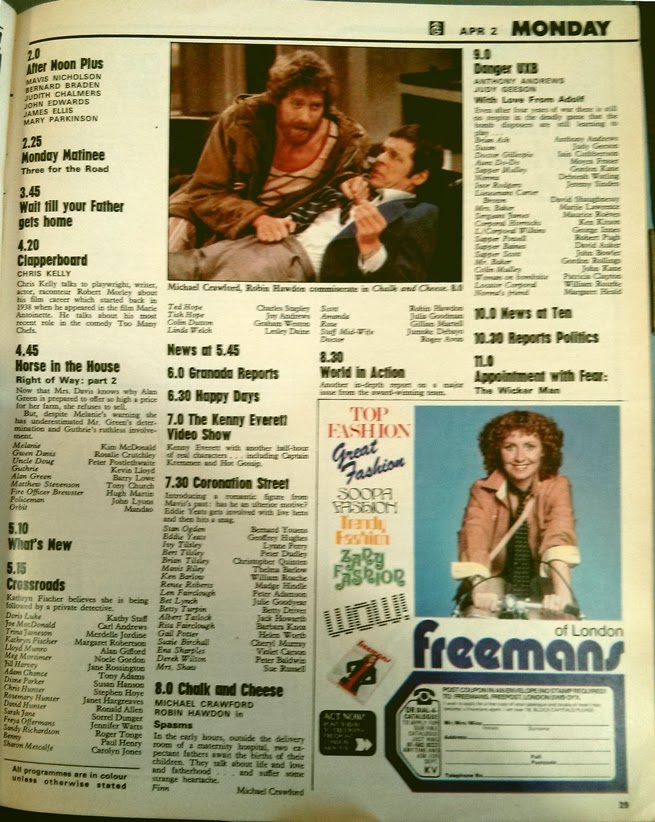
Compared to other Euston Films series of the time, Danger UXB was not an overwhelming ratings success. Only four episodes made it into the top twenty, episodes five, nine, twelve and thirteen. The latter did well, with 16.05 million viewers, only 600,000 viewers behind Coronation Street, boosted perhaps by the heavy promotion given to Thames's Michael Crawford sitcom Chalk and Cheese which ran in the half-hour 8pm slot for the last two weeks of Danger UXB's run. Its series format masked serial elements (as Neame notes in his book) and if the difficult shoot he recounts prevented it from becoming a Thames/Euston banker, then as it stands it occupies a transitional space between Euston's long-running series such as The Sweeney and Minder, and the format which other Euston projects of the time (such as Out and perhaps also Quatermass) were exploring, the self-contained 'television novel'.

Danger UXB is available on DVD from Network

Sunday, 20 October 2013

Transatlantic Tomorrows: reinventing The Tomorrow People

Having republished a review of the original 1970s series earlier this year, some thoughts on the new version of The Tomorrow People might be in order. The two episodes of the CW's commission which I've seen sadly lack a vital spark. More than that, they miss the hope, however naive, which sustained Thames Television's series even as the budget drained away and changing trends in youth and political culture began to challenge writer Roger Price's ideals. Instead unattractive characters find ways to hurt each other and express their anomie within the confines of a reworked The Slaves of Jedikiah, now hung over a framework of paranoia about government surveillance and genetic modification tied up with off-the-peg concepts of a messianic hero's search for his missing father. The recreators of the series, Greg Berlanti, Phil Klemmer and Julie Plec, need to find more imagination, extract more charisma from their leads, and give the new Tomorrow People more to live for than the freedom to be citizens of a world viewed through a dystopian lens.

Sunday, 25 August 2013

Tower of London (1939)

Tower of London is near-contemporaneous with the setting subject of my last post here, Edward & Mrs Simpson, but is set at over four hundred years' distance rather than forty. Nevertheless, the scroll which opens the narrative would have left filmgoers in little doubt that they were watching a film with contemporary relevance. There were many ruthless men determined to leave dark stains upon the pages of history in 1939, and the failure of the Munich agreement showed that tomorrow's enemies were already here. Like the film's Henry Tudor from France, many residents of the United States watched from over the sea as their ancestral homelands fell subject to what many would explain as self-interested misgovernment.

Director Rowland V. Lee seems to have used as many British actors as possible, at least where the male characters are concerned. Miles Mander, younger brother of a British Liberal anti-appeasement MP, Geoffrey Mander, plays Henry VI as a confused old man overtaken by events; with his white hair, moustache and beard, Mander's Henry looks more like a ragged version of his brother's target Neville Chamberlain than the pious clean-shaven Henry of the portraits. His enemy Edward IV is embodied in jovial brutality by Ian Hunter, a less powerful but comparable grandperformance to Keith Michell's Henry VIII in BBC Television's The Six Wives of Henry VIII thirty years later. The working classes are represented by a self-promoting and exploitative but ultimately dependable chimney-sweep, Tom Clink, played by Ernest Cossart, younger brother of Gustav Holst.

John Sutton, playing the film's ostensible romantic hero John Wyatt, was from British India and his character is a cut-price version of the kind of role played by his fellow member of the imperial diaspora, Errol Flynn, in whose support he had been previously cast in The Dawn Patrol and The Private Lives of Elizabeth and Essex. He carries some physical action but is mainly a symbol of hope, of marriage (and 'normal life') deferred for the people of England as embodied in the virtuous but passionate and plucky Lady Anne Barton (played by Texan actress Nan Grey). Both Wyatt and his lady are fictitious but at least one detail of Wyatt's storyline, his imprisonment in the Tower, seems to be derived from the legends which accrued around Henry Wyatt, father of the poet Sir Thomas Wyatt.

The stars, though, are unquestionably Basil Rathbone as Richard of Gloucester, and Boris Karloff as his enforcer Mord. There's a cold charm to Rathbone's Richard which is so precise as to be disarming. Indeed, his private miniature tableau of naively-crafted figurines, whittled down to one over years as Richard disposes of successive family members, is endearing in its simplicity. We can believe that his nephew Richard of York would include "I like Uncle Richard" in his last prayer. Richard is playful and death is his game. Indeed, he does away with his elder brother the duke of Clarence (Vincent Price, visibly much younger than Basil Rathbone despite the best efforts of Rathbone's make-up) by tempting him with the entire Warwick inheritance if he wins a drinking contest, leaving him drunk enough to meet his vinicultured fate. The reason the film shows very little of Richard as king is that there is no-one important enough for him left to murder before Henry Tudor arrives to slay him at Bosworth, both in terms of the film's plot and for Richard as a character.

Mord is the film's invention, a club-footed, bald grotesque whose ears adhere more closely than is usual to his skull. He's a physically deformed and embittered lower-orders counterpart to Richard. He's another opportunity for Universal to present Karloff beneath 'monster' make-up, but also exhibit his talent for physical performance. There's something of the class warrior about Mord, taking revenge on the nobility through beheadings, stabbings and (last but definitely not least) drowning in Malmsey wine, on behalf of the masses. Yet a more urgent compulsion for Mord is the need to be recognised as human, as a man, as a warrior. He begs that Richard let him come to fight at Tewkesbury, but Richard refuses, preferring that Mord plot on his behalf from the shadows rather than take up arms for the wider Yorkist cause. The depiction of Mord's dejection as Karloff takes him back through a Tower gateway, dragging his foot behind him, framed in silhouette, is skilfully done. Mord's devotion to his fellow-sufferer, the crookbacked Richard, is encouraged and exploited by Richard, but nowhere does it appear that Richard's infirmity holds him back. Mord lacks self-belief, but he does believe in Richard. At the end, he fights bravely and well until he sees his master killed; any sympathy the audience might feel for him is challenged when he attempts to fly the field. He is eventually defeated in single combat, but it takes a nobleman to do it.

The opening roller referred to the pages of History, as if it were a foreign land. Though the architecture of the real Tower of London is closely honoured in the long (model? or photographic?) shots, the general shape of the sets owes much to Universal's Mitteleuropa of its earlier horror cycle, though augmented with the appropriate English royal arms for the period. However, the mingling of British and various American accents (including a very southern accent for the five-year-old Richard, duke of York, in his wedding scene) suggests that this is a film made for a United States which very much still saw English history as the main root of its traditions. Richard III might pose as a man of the people, but appeals to the mob (it's tempting to see parallels with Hitler's use of the plebiscite) are no substitute for the rule of law and respect for the wishes of the individual. It's only the advent of Henry VII which allows John and Anne to marry.

Tower of London presents an abbreviated storybook history which concentrates on the villainy of one prince and his henchman. Character suffers: Anne Neville is introduced as the loving wife of Edward, prince of Wales (G.P. Huntley, cast only as sword fodder) but disappears once she is married. The mature leading female role is Queen Elyzabeth (the only name to suffer a cod medievalisation) who suffers from a vocal delivery, gestures and facial expression which suggests Barbara O'Neil was playing to the back of the stalls. Unlike a more recent treatment of this historical period - the BBC adaptation of Philippa Gregory's The White Queen and its sequels - the emphasis is on the fate of a people rather than on the careers of individuals, magic is absent, God is taken for granted (and mocked by Richard as Mord does away with Henry VI) and while liberties are taken with chronology, no-one lives who shouldn't (though some, such as Hastings, just disappear). However, Tower of London works well as a catalogue of grand villainy and the degradation of a people, with the promise of redemption through the intervention of an overseas ally. Physical horror happens mostly just off screen, aside from the bloodied heads in the battle scenes, too real to be made sardonic joke of like stabbings and drunken drownings. Richard survives for so long because Edward IV keeps postponing the cause of right for the benefit of exigencies; his sons (dressed straight out of Millais) pay the price, much as populations were being sacrificed to the rule of Hitler as a result of appeasement. Neither Richard nor Mord is a Hitler, for they are drawn too broadly and their villainies are too specific, but the appeal to the American audience to look at events across the Atlantic is clear.

Poster image courtesy of classic-horror.com.

Sunday, 4 August 2013

Edward & Mrs Simpson (1978)

The latest addition to my collection of portrayals of royalty on television is Edward & Mrs Simpson, produced by Thames Television for ITV in 1978. Like ATV's Edward the Seventh three years before, it took a biography as its source and liberally drew on quotations from correspondence, reported speech and authorial commentary for setting and dialogue. The biography was Edward VIII, published in 1974. Its author, Frances Donaldson, was credited as series adviser. The screenwriter was Simon Raven, much of whose writing had concerned the upper and upper-middle classes of English society. This included both his novel sequences and his television work, including his responsibility for the BBC's epic Anthony Trollope adaptation The Pallisers (1974). Raven's social persona reportedly left those he knew debating whether he was cad, angel, or both - something that might have been said of Edward VIII himself.

There's a self-awareness to the casting which tempts the informed viewer to see Edward &Mrs Simpson as something of an inside job, an emanation from the slightly raffish side of the British establishment, paying its way by commercial breaks. Edward Fox, playing Edward VIII, was the nephew of Frances Donaldson. His first wife was the granddaughter of Freda Dudley Ward, the most enduring of Edward's mistresses when he was prince of Wales, infamously dismissed with the words from the palace switchboard "I'm sorry, but I have orders not to put you through."

Appropriately for a drama leading up to an event which interrupted and accelerated hereditary succession, Edward & Mrs Simpson draws on a wider sense of theatrical genealogy. Several of the older historical figures are personified by actors whose careers were already well under way when Edward VIII left the throne in December 1936. Peggy Ashcroft plays Queen Mary; Jessie Matthews, Wallis's aunt Bessie Merriman; Maurice Denham, Cosmo Gordon Lang, archbishop of Canterbury; Marius Goring, a fatalistic George V. Sibyl Colefax[1] is played by 1920s and 30s comedienne Elsie Randolph. Andrew Ray, as the Duke of York, was the son of 1930s radio comedian Ted Ray. These decisions make Edward & Mrs Simpson not a detached historicisation of events or fictionalised reinterpretation like many more recent television dramas, but an extension of the dance suggested by the title song, Ron Grainer's arrangement of Herbert Farjeon's I've danced with a man, who's danced with a girl, who's danced with the Prince of Wales.[2] Many of the key participants in events were very much alive in 1978, with Mrs Simpson herself, the Duchess of Windsor, a haunting presence not that near the back of the minds of the royal family and household, however fragile she seemed in her house in the Bois de Boulogne.

No conclusive psychological portrait is drawn of the eponymous subjects. At best, both lie outright to those closest to them, but neither are clear what their goals are or can admit as much to themselves. Perhaps Simon Raven was as baffled as Stanley Baldwin professed to be by the king's decision. Much depends, for the viewer, on observation of carefully rehearsed body language and facial expression. Early in the first episode Edward, still Prince of Wales, is the focus of a round of For he's a jolly good fellow in a regimental sergeants' mess. Edward Fox's face is that of a man who doesn't believe it's possible that he can be jolly good. Edward's self-doubt is ignored by his parents and managed by his two mistresses, responsible big sister Freda Dudley Ward and naughty little sister Thelma Furness. Both Kika Markham and Cherie Lunghi endear in these roles - it is their subjects who might grate - and it's a pity, though absolutely necessary to the storytelling, that we never see either of them after the first episode. Though the script and Cynthia Harris's performance suggest that the audience is at first expected to warm to Wallis in episode one, after she shows no enthusiasm for Thelma's safari tales (which follow extended film sequences of animals being slaughtered for fun by Edward and Thelma in East Africa), her appropriation of a vulnerable man is gauche and based upon partial misreadings.

Drama which draws on non-fiction while still being drama is prone to rearrange matters. The stammering but resolute Duke of York tells his wife that "I'm only a naval officer," and not (as historically) his cousin Lord Louis Mountbatten. The impression is left that Edward meets Wallis for the first time in London and not in Melton Mowbray, more fitting perhaps for a man who sought refuge in a metropolitan smart set.


Director Waris Hussein was by this point extremely adept at realising pasts recent and remote both on film and video and he makes use of the mixed media television drama format well. Wallis's jewellery sparkles in the grey reality of studio-London flats and Suffolk beaches; the yellows of Fort Belvedere suggest a golden fantasy from which Edward could never quite be awakened. There is a particular shot, in soft focus, of Edward and Wallis walking through a field, romantically framed through flowers, which then crashes back into the hardness of politics: studio lights, video cameras, portrait shots of visibly ageing men talking. There's a desolation to the final shot of Edward and Wallis being driven away from their wedding across a sterile gravel road: how much energy has been expended for an unproductive future.

Edward & Mrs Simpson is available on DVD in the UK from Network.While my secondhand copy looks like the image above, the release has since been rejacketed as right.


---------------
[1] Colefax's inclusion in the narrative is cunning: the socialite and decorator was a niece of Walter Bagehot, who famously defined the powers of the British monarch as the right to be consulted, the right to encourage, and the right to warn.

[2] The song was mentioned on camera by the Duchess of Windsor herself in A King's Story (1968). Thanks to Jim Smith for this reference.


Thursday, 25 July 2013

Fit for a (future) king: George, Alexander, and Louis

Following yesterday's post, I thought of another which I thought had a more natural home than this site. Written overnight and edited today, Fit for a (future) king: George, Alexander and Louis can now be read at the Oxford University Press blog, with links to selected (paywall-free) Oxford Dictionary of National Biography entries. The symbolism of royal naming patterns is a potentially large subject, and thanks to all at the OUP blog and Philip Carter at the ODNB for allowing me a generous word count.

Wednesday, 24 July 2013

Counting kings and queens

It's often been said in the last few days (for example, at The Guardian) that Prince n of Cambridge will, all being well, eventually become the forty-third king since William the Conqueror. However, said invader was never king of Scots, and the new prince is as much a prince of Scotland as he is of England.

Turning to the list of Scottish monarchs in the trusty Oxford Dictionary of National Biography, copying it to a spreadsheet (purely for arithmetical reasons) and deleting unwanted copy, including sub-headings, and a second reign (Donald III, part two, 1094-1097), it appears that Prince n of Cambridge will be the sixty-third king or queen of Scots since Kenneth I/Cináed mac Alpin became king of the Picts as well of the Scots of Dalriada in 842. This excludes figures such as Amlaibh, included after or alongside Indulf in the Wikipedia list, as well as Edward Balliol who reigned in opposition to David II in the fourteenth century, but includes Margaret the Maid of Norway, the 'lady of Scotland' or queen-designate in ODNB terminology.

Kenneth has over two centuries' advantage over William I of England, however, so picking Malcolm III/Mael Coluim Ceann Mór/Malcolm Canmore (reigned 1058-1093), the twentieth on the list, as William's nearest contemporary, this makes the prince the potential forty-fourth king of Scots since Malcolm III inaugurated the continuous succession of Scots kings descended from his father Duncan I (reigned 1034-1040).