Saturday, 12 May 2012

Ponteland Observed, part five

This series of posts have largely been written from a point of view which my teenage self in the mid-1980s would have recognised, looking at newspapers as art or craft rather than as business. They have, however, emphasised the importance of the presentation of the local newspaper and the thought that goes into establishing its character. Neglecting the coherence of the content undermines a paper's relationship with its readers.

The business context for the launch of the Ponteland Observer was challenging. The early 1980s were not a good period for paid-for weekly newspapers in north-east England. Titles owned by Westminster Press were among the worst affected. In Northumberland, the long-established News and Post covering Blyth and Ashington reversed into the freesheet Leader to become the News Post Leader, whose editorial content was much lower than the old papers. A similar fate affected the Shields Weekly News and the Whitley Bay Guardian, which merged to become the News Guardian with a mix of free and paid distribution. Worse happened in County Durham, where in 1986 all Westminster Press’s paid titles except the Darlington and Stockton Times disappeared, with the Durham Advertiser (having already abandoned its Durham Chronicle variants, a legacy of a much earlier merger, in 1984) reversing into the Shopper series of free titles, bequeathing them the Advertiser name, and the Stanley News and Consett Guardian closing. As part of the same process the Darlington evening paper the Evening Dispatch closed. The remaining Tyneside and Northumberland titles, under the company name Northern Press, being the Northumberland Gazette (including the Morpeth Gazette and the Ponteland edition), the News Post Leader, the News Guardian, the daily evening Shields Gazette and a further free weekly in Berwick, the Berwick Leader, were sold to an out-of-area investor. The remaining Westminster Press company, North of England Newspapers, concentrated on developing The Northern Echo, its Darlington-based daily circulating from Tyneside to York.

The growth area in north-east weeklies in the 1980s was the freesheet. The existence of an audience to be advertised to was a certainty; who that audience was, beyond generalisations about income and spending, was less certain with the shrinking of traditional industries and community leisure activities. The four main newspaper groups in the north-east - Westminster Press (as North of England Newspapers), Thomson Regional Newspapers (surreptitiously, on Tyneside at least, as ‘Warrington & Co.’), Portsmouth and Sunderland Newspapers and Northern Counties Newspapers (later Reed Northern Newspapers) - competed fiercely in this market, with several mergers and exchanges of titles over the period in question.

Against this background the woes of the Ponteland Observer might appear a sideshow to the main commercial arena, but the existence of the paper did reflect an awareness that there was a growing prosperous rural-suburban area in Newcastle which was potentially not being served by the existing media. Ponteland had rejected incorporation in Newcastle in the early 1970s but was visibly growing and had an identity distinct from the declining industrial centres of south-east Northumberland. If a new paid-for title with more cachet and a stronger editorial focus than the freesheets was to be launched anywhere in the north-east in 1982, Ponteland was a tempting location.

The Ponteland Observer faced substantial obstacles. Newcastle’s morning and evening papers were both strong, the Evening Chronicle in particular enjoying substantial sales. Both the Chronicle and its stablemate The Journal would pick up major Ponteland stories and carry advertising for Newcastle . Many of Ponteland and Darras Hall’s executive homeowners commuted to Newcastle and their concerns were shared with the wider city region. At the same time, the Ponteland Observer’s inevitable emphasis on Ponteland’s economic development contrasted with Ponteland’s self-image as a rural village to which the large upmarket housing estate of Darras Hall happened to be attached.

The Tweeddale Press Group’s interest in acquiring the title following Michael Sharman’s death was presumably a natural development of their ongoing expansion into Northumberland from their border roots. Jim Smail had opened The Alnwick Advertiser in 1979, directly competing with the Northumberland Gazette on its home ground. Acquiring the Morpeth Herald in 1983 advanced further into the territory of a weakened outpost of a major group. The Ponteland Observer was a additional push, directly challenging all three editions of the Gazette with distinct titles. While The Alnwick Advertiser showed in its name that it was spun off from the Tweeddale Press’s first newspaper, The Berwick Advertiser, the Morpeth Herald was home-grown with a long tradition of independence in the face of competition from the Gazette and News Post. While the Ponteland Observer was founded by an editor with long experience on the Hexham Courant and on the Tyneside dailies rather than someone already involved in Ponteland life, its office was in the heart of the village and it had been assiduous about establishing links with local businesses and societies.

The merger of the Morpeth Herald and the Ponteland Observer helped the reorientation of the Morpeth Herald from being a Morpeth town paper to being a paper for Castle Morpeth borough, including a swathe of territory previously not in the paper’s coverage area. This took some years to be apparent, but within a few years of the merger a Ponteland photographer was on an exclusive retainer with the Herald, with the intention of limiting the Gazette’s Ponteland coverage. The editorial development of the Herald, once the Observer had been absorbed, saw a greater emphasis on page layout and indeed greater internal sectionalisation, developing an opinion and letters page and a features section which brought its appearance at the end of the decade closer to that of the Ponteland Observer before the Tweeddale Press acquired it. The replacement of the Tweeddale Press’s presses, too, helped modernise the look of the papers simply by making them several centimetres narrower, as well as allowing sharper definition and spot colour.

The acquisition of Northern Press by Portsmouth and Sunderland Newspapers at the turn of the 1990s brought improved production standards, a new company name in Northeast Press, and a relaunch to the Northumberland Gazette series, which could now be printed in colour in Sunderland. The Ponteland edition became, on its masthead at least, a fully-formed Ponteland Gazette, but it was still only a variant front page for the Morpeth Gazette. In 1992 Northeast Press then pushed into Tweeddale Press territory, acquiring and relaunching the Selkirk Weekend Advertiser in The Southern Reporter’s heartland. The response of the Tweeddale Press was to withdraw from south Northumberland. The Alnwick Advertiser and the Morpeth Herald were sold to Northeast Press, who now adopted the Tweeddale Press’s one newspaper per district council pattern. An editorial thanked the Tweeddale Press Group for having nurtured the Herald so that it and not the Morpeth Gazette survived the merger process. The Ponteland Gazette disappeared, it and the Morpeth Gazette joining The Alnwick Advertiser in being formally incorporated into the Northumberland Gazette at Alnwick. The Morpeth Herald, still incorporating the Ponteland Observer, continued as a distinct title sharing advertising and occasional supplements with the Northumberland Gazette but maintaining its own editorial and visual identity. During 1999 both Northeast Press’s parent company Portsmouth and Sunderland Newspapers and the Tweeddale Press Group were bought by Johnston Press, and the Northeast Press and Tweeddale Press titles were then rearranged into geographically coherent units for management purposes.

Thursday, 10 May 2012

Ponteland Observed, part four


The Ponteland Observer continued throughout 1985, maintaining what it could of its original character when spliced into the Tweeddale Press Group’s East Northumberland and eastern Borders format. From looking at one of the issues I have, there seems at one point to have been an attempt to have a women’s page shared with some of the sister titles, with the Observer-style page heading replaced by a generic one and Ponteland-specific features on one side of the page only. Ponteland High School’s High-Lights supplement continued, remaining tabloid by being printed at right angles to the rest of the paper. Some variety emerged on the sport page, with definite attempts to have Ponteland lead stories amidst the copy shared with other Tweeddale Press papers.

There were several changes for the worse. The personality profiles faded away, as did the leader column, contributing to the sense of remoteness from Ponteland the advertising from places as distant as Dunbar could create. Where the old Observer had been able to break up the text on its small pages with plenty of images at a higher than usual resolution for 1980s newspapers (though occasionaly needing work on contrast) the broadsheet paper, produced on a letterpress machine with photopolymer plates, tended to have only one or two photographs on a news page and often concentrated its photographic content on ‘picture pages’, reminiscent either of newspapers in the early days of photographic reproduction or of the glossy regional business magazines. 

A full picture of the Ponteland Observer’s circulation is difficult to come by. An unaudited figure given early in 1984, under Ponteland Observer Ltd’s ownership, was 2000; a media reference book for the start of 1986 gave an audited figure of 1200. Both figures were substantially lower than the rest of the Tweeddale Press Group titles or neighbouring weekly papers. A glance through the Observer suggests that firms and individuals from the Observer’s circulation area weren’t advertising with the Tweeddale Press Group to the level that must have been hoped for.
 
The end came with the issue of 9 January 1986. Next to a very detailed report (let down somewhat by a tautologous headline) on the united opposition to Barratt’s plan to build on 475 acres of land west of Darras Hall, and a picture from the New Year wheelbarrow race in Ponteland, came a statement from the board of the Tweeddale Press Group. Unlike previous messages, this was not formed as a personal statement from Jim Smail, although he was quoted as chairman. It explained that the favourable circumstances which had allowed the company to continue to publish the Ponteland Observer ‘for longer than its trading deserved’ had passed, and so as from the issue of 16 January the Ponteland Observer would be incorporated in the Morpeth Herald and the Observer office at The Smithy Side, Bell Villas, would close. 

This was the last word; there was no goodbye from the Observer team itself, but the Ponteland telephone number had disappeared from most lists of group contacts on the classified pages. The contents suggested that the Ponteland office was already winding down, with some Morpeth stories intermingled with Ponteland area ones on page 3. The Observer circulation area news included a planning appeal rejection in Heddon, plans approved for the expansion of takeaway food facilities at a Ponteland solarium, and New Year Honours for residents including athlete Steve Cram, then resident in Dinnington. The leisure page at least went out asserting something of its old personality, with a profile of young Ponteland woman Sarah Pain who was planning to visit Tasmania and the Antarctic during 1986, Bobby Thompson’s gardening column, and some pictures of activities by Ponteland Village Children’s Association; it also included a cinema preview, however, referring to a screening at the Coliseum in Morpeth. Ponteland didn’t feature on the sport page at all, and much of the remaining copy, perhaps reflecting the time of year, was shared with the group, including a feature on RAF Boulmer and the farming page, which concentrated on changes in the coming year for Scottish farmers.

As with the first broadsheet Ponteland Observer, the Morpeth Herald letters column appeared on the shared page 2, still looking very out of place in what was supposedly a Ponteland paper. This time the Observer letters column itself appeared on page 6, leading with a letter headed ‘Housewife’s plea for supermarket’. Anne Morgan explained her support for the arrival of a Presto supermarket, which had met some local resistance, outlining (in her view) the inadequacies of the C0-op and William Low branches and the independent supermarket Waudby’s, and the lure of Presto at Kingston Park. If the Ponteland housewife with a family was a key part of Michael Sharman’s intended readership for the paper, it was appropriate that a representative of that group was given prominence at the Ponteland Observer’s end.

 The next week the Morpeth Herald appeared with its masthead redesigned to include the prominent subtitle incorporating the Ponteland Observer, Est. 1982 in the centre. Cooper Black Condensed was banished in favour of a wide Roman typeface more complementary to the Herald's Gothic. Attachment to incorporations and foundation dates was part of the Tweeddale Press Group’s house style. Their flagship title in Selkirk, The Southern Reporter, cited under its main title at this time I think the names of four newspapers it had absorbed earlier in its history, complete with their years of establishment. This appealed to those of us with a sense of tradition, as well as upheld The Southern’s commercially valuable claim to represent several communities in the shires of Roxburgh, Selkirk and Peebles; though some might find such headings ‘cannibalistic’, as A.J.P. Taylor once said (unfairly) of the New Statesman when it went under the title The New Statesman and Nation incorporating The Athenaeum: The Weekend Review.

This first amalgamated paper included a few Ponteland stories, and (ironically given the tendency of Morpeth Herald letters to turn up in the Ponteland Observer) its Letters to the Editor were all from Ponteland correspondents responding to the final Observer letters page. After all its troubles the Ponteland Observer had evidently maintained its usefulness as a sounding board for the aggrieved. However, the Herald’s core readership was in the north of Castle Morpeth borough and over the succeeding months and years its content remained focused on Morpeth and surrounding villages such as Pegswood, Mitford and the coastal area to the north-east including Lynemouth and Newbiggin. Ponteland was represented by occasional picture stories and sport coverage. High-Lights continued until summer 1988, at first thanks to the support of Adrian Hogg, the Herald’s editor until the end of 1987 and a Ponteland resident, but also reflecting a Tweeddale Press Group interest in building links with schools across their coverage area. The most enduring Observer feature was Bobby Thompson’s gardening column, which continued in the Morpeth Herald almost until its author’s death. Over the next few years first the Est. 1982 was dropped from the Herald masthead, and then incorporating the Ponteland Observer was moved to the left of the masthead with Ponteland Observer progressively reduced in size, though it has not yet disappeared.

The next and final post in this series will look at the wider context in which the Ponteland Observer operated, look at its legacy in local news coverage in Ponteland, and examine whether anything can be learned from its story which can be applied to the current debate on localism and hyperlocalism in British news media.

Friday, 4 May 2012

Ponteland Observed, part three

The first broadsheet edition of the Ponteland Observer appeared as promised on Thursday 5 July 1984. The crowded front page featured a prominent publisher's statement by Jim Smail, justifying the decision to make the Observer a broadsheet in similar terms to the editorial the previous week in the last tabloid edition. Classified advertising was to be shared with the Morpeth Herald and other sister papers in the Tweeddale Press Group; the development of the paper before it was acquired was praised, the tragic circumstances of the purchase alluded to, and the 'growth of the paper in its own right' established as an aim. Below the fold a list of contents directed readers to where they could find Ponteland Observer contents within the paper.

This was a necessary point, because the relaunched title was a hybrid of copy generated in the Observer office in Ponteland, advertising gathered by various Tweeddale Press offices in the Borders and Northumberland, and news pages from the Morpeth Herald. Where the Observer pages sought to retain the design and editorial principles established while the paper was independent, with the Cooper Black Condensed versions of the page headings surviving on the Women and Leisure pages, together with the Comment box on the opinion and profile page, they were intermingled with pages from a newspaper with a very different personality, which didn't classify its contents in the same way. There was seemingly little care taken as to which pages from the Herald were included in the Observer. For example, while the Observer letters page was absent in this issue, page 2, sourced from the Herald, contained 'Letters to the Editor' which were exclusively Morpeth-based. An advertisement for a Morpeth restaurant on the same page extended 'congratulations and best wishes to the Morpeth Herald on its merger with the Ponteland Observer'. This seemed to contradict the proprietorial statement that the titles would remain distinct while sharing common news of Castle Morpeth district. Matters did not improve over the succeeding weeks. While Morpeth-based news was to be expected in the new format, Herald-specific features such as the letters page or columns such as Roland Bibby's 'By Font and Wansbeck' frequently crept into the Observer's pages. That summer, the Observer's support for Ponteland's campaign in Britain in Bloom would be compromised by advertisers and Herald stories on surrounding pages supporting Morpeth's attempts. Worse still, it was sometimes noticeable that the Herald bundled in press releases with no evident contextualisation - a story about telephone number changes in parts of Newcastle appeared at the foot of one Herald page without it being explained to whom the story related.

Jim Smail had apologised to those readers of the Ponteland Observer who objected to the broadsheet format. He didn't acknowledge how unusually broad the paper was, at 920mm when opened out, a good 170mm wider than the average. This archaic paper size was complemented by the new masthead's combination of conservative subheadings 'Incorporated with the Morpeth Herald' and 'Established 1982', in the Tweeddale Press's house style, and an informal title font with a simplified drawing of Ponteland church, bridge and Diamond Inn, replacing the more detailed drawing by Ponteland student Nicola French, and perhaps drawn by someone less familiar with the location. The appearance of a 'picture page' of photographs was well-intentioned but drew attention to the diminished print resolution and the lack of editorial to support them. The dual personality - only integrated on the entirely merged sport pages - undermined the Observer as a proposition for established readers; if weekly local newspapers are a lifestyle choice, it was unclear which lifestyle was being bought.

While the Tweeddale Press Group pursued the line that the new arrangement allowed Ponteland readers to read more news of their local area, the association of Ponteland with Morpeth in Castle Morpeth borough was only ten years old in 1984. While the Ponteland Observer was itself a new paper for a growing commuter settlement, the Morpeth Herald had first appeared in 1854 and catered to an established market town which acted as a gateway between rural mid-Northumberland and the more industrialised areas of Ashington and Blyth in the south-east of the county. Until February 1983 it had been published by several generations of the Mackay family, who held out on vintage equipment - some dating to the early nineteenth century - against competition from newspapers published by larger groups with more resources. After two months the Tweeddale Press - whose own Alnwick Advertiser, retitled for a while as the Alnwick and Morpeth Advertiser, had been competing with the Herald - relaunched the Morpeth Herald within their own series. Reorientation away from the Herald's traditional hinterland began immediately - the subtitle 'Ashington, Blyth & Bedlington Reporter' was dropped, and there was even a police report from Darras Hall tucked away on the front page, perhaps (and only perhaps) a clue that the Tweeddale Press were looking to prosperous Ponteland even then.

The Observer's newsgathering was impressive, and notes on a new car and a feature on a play at Wallington Hall in the first issue showed that it still had the affluent leisured reader in mind. However, the Tweeddale Press's group features on farming and on (for example) care homes were more generally focused. The feeling in Ponteland seemed to be that the new Observer had 'gone county' and that despite the presence of a Ponteland office and the large number of stories editor Susan Calvert and new reporter Catherine Siddall generated, it was insufficiently distinct from the Ponteland edition of the Alnwick-based Northumberland Gazette, then owned by Northern Press and against which the Tweeddale Press's Alnwick Advertiser was positioned as an upstart competitor.

The end of August saw a rethinking of the Tweeddale Press Group's titles which included a decision to share less editorial and advertising between titles and pursue the development of each individual newspaper's business. Jim Smail took the opportunity to review the progress of the Ponteland Observer on its front page, but appealed to Ponteland residents to recognise what a good business proposition the Observer was, tied into an advertising market reaching from south Northumberland to the Firth of Forth. A minor relaunch followed, with the 'Incorporated with the Morpeth Herald' subtitle disappearing and Nicola French's artwork returning to the masthead. However, a proportion of editorial from the Morpeth Herald continued to appear, sometimes including material critical of wealthy Pontelanders whose demands unfairly sapped resources from Morpeth and the poorer mining or agricultural villages surrounding it. There was a tension between editorial strategies and economic necessities which was proving difficult to bridge.

UPDATE 4 February 2025: For over thirty years I'd been under the impression that the issue of the Morpeth Herald to the right of the fourth paragraph was the first issue of that title published by the Tweeddale Press Group, as it was labelled as such at the old Newcastle Central Library. I've now discovered, through the British Newspaper Archive, that it was not, but that the Morpeth Herald resumed publication a week earlier, on 14 April 1983, with a front page editorial from Colonel Jim Smail.

Wednesday, 2 May 2012

Ponteland Observed, part two

By the start of 1984, the Ponteland Observer was circulating in Ponteland, Darras Hall, Belsay, Stamfordham, Matfen, Heddon, Whalton, Prestwick, Dinnington, Kingston Park, Woolsington and Kenton Bank Foot. Its masthead strapline had changed to reflect this fact: no longer was it only 'Ponteland's own independent newspaper', but 'Castle Ward's independent newspaper'. This might seem an odd decision. Castle Ward Rural District, based on Ponteland, had been broken up in 1974, with most of the area remaining in Northumberland within the new Castle Morpeth Borough district, but the most populous areas (other than Ponteland and Heddon) joining the enlarged City of Newcastle upon Tyne within the new metropolitan county of Tyne and Wear. Nevertheless, for many years Castle Ward still existed on the ground, with notices of by-laws and other regulations issued by Castle Ward slow to disappear if they were not superseded, and most obviously the sports centre in Ponteland, which hosted many of the activities covered by the Observer, still carried the name 'Castle Ward Sports Centre'.

Most importantly, the Castle Ward identity pointed towards where Michael Sharman planned to take the business. The circulation and advertising base needed expansion, and a sister title in Gosforth was intended. Gosforth, a distinct community immediately north of Newcastle until its incorporation in the city in 1974, was larger than Ponteland, with many more businesses, but a comparably wealthy demographic. Launch of the Gosforth Observer was scheduled for May; local gossip suggested that it would be a freesheet rather than a paid-for title, but this was never set down in a printed source. In order to devote himself to the Observer, Sharman resigned from the Hexham Courant.

Issue 84, dated 4 May 1984, proved to be the last regular edition of the Observer in its old format. This was a twelve-page issue, the four centre pages being taken up by an issue of High-Lights, the Ponteland High School newspaper. The main story concerned the possibility that a Castle Morpeth Borough Council depot could be converted into a permanent youth centre, superseding the small Ridley Youth Hut in the grounds of Ponteland High School. There were plans for a private hospital on Callerton Lane; and the two smiling young women were from Kirkley, north of Ponteland, having been chosen by the Milk Marketing Board to be 'Dairy Maids' for Northumberland and Tyneside respectively. On the back page, football team Ponteland United were celebrating a 4-0 victory over Annitsford Welfare in the Heddon Homes cup; Ponteland and Kirkley cricket clubs and Ponteland 1st XV rugby clubs celebrated victories too, while six-year-old Scott Dixon had joined Ponteland Golf Club and was pictured practising his swing with his father and grandfather assisting. Inside, the Windsor pub in Kingston Park had seen its leek club undertake a charity bike ride in costume; Ponteland businesses condemned the introduction of trade refuse collection charges by Castle Morpeth council; the Northumberland Theatre Company visited the Memorial Hall with Educating Rita, and assistant editor Susan Calvert interviewed D-Day landings veteran Leslie Salkeld of Dinnington, leaving 'laden with plants', but having heard about his plans to donate his collection of documents, photographs and equipment (pictured) to a new museum at Inverary Castle.

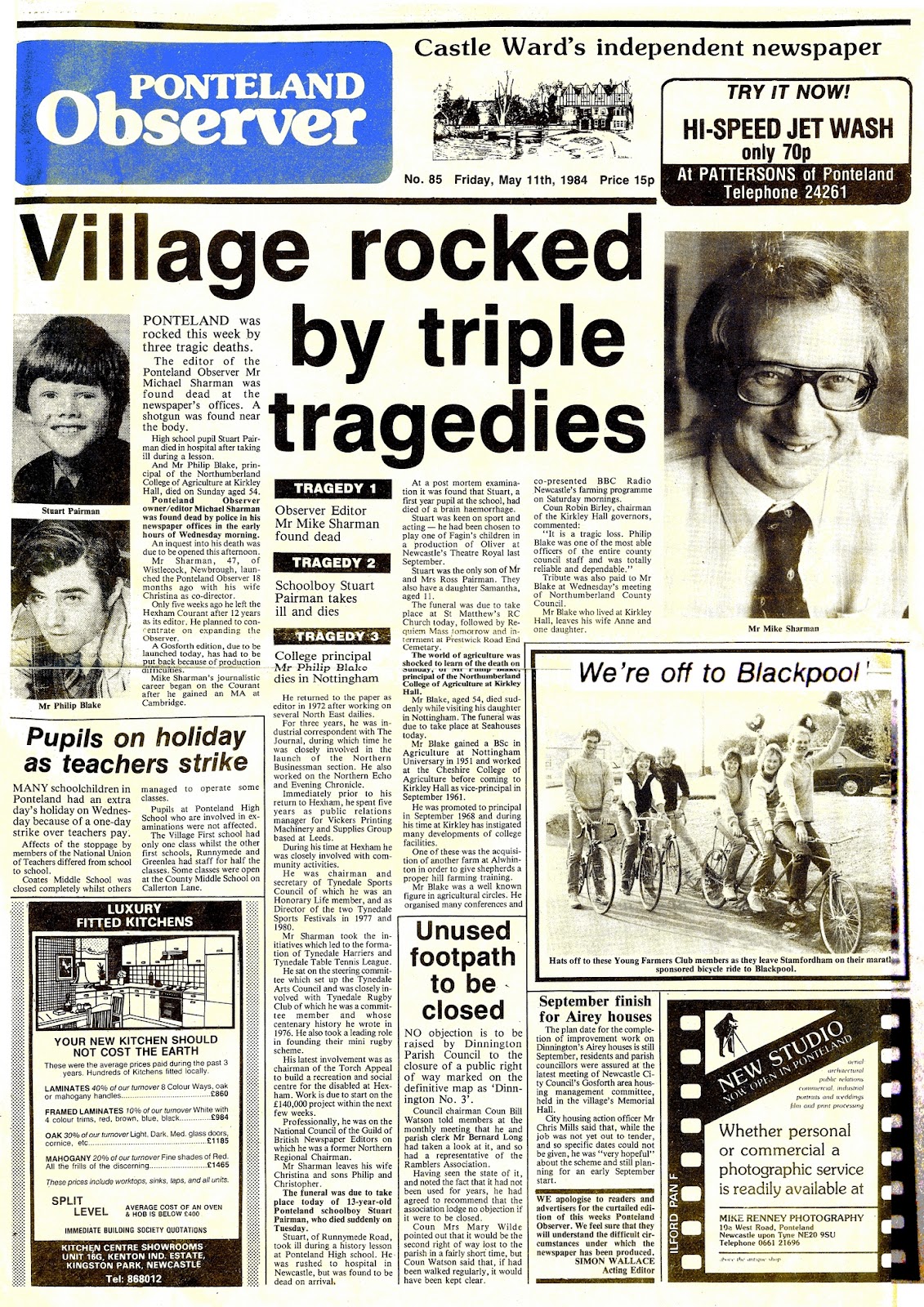
The next issue did not appear as planned on Friday 11 May, only reaching newsagents in the middle of the following week. It was produced under crisis conditions. The first of the 'triple tragedies' announced in the headline was the death of the editor-publisher himself. Michael Sharman had been found dead in the Ponteland Observer offices on the morning of 9 May, with a shotgun beside his body. The story reported that the Gosforth edition of the paper, due to be launched on 11 May, had been put back because of 'production difficulties'. Acting editor Simon Wallace - a business neighbour of the Observer, and a regular columnist - apologised for the 'curtailed edition' but felt sure that readers would understand the conditions under which the paper had been produced. Some of the copy - including the main article on page 3 concerning Gosforth rent arrears, and the article on the property pages about Granvilles estate agents - had clearly been intended for the Gosforth paper. The editorial described Michael Sharman as 'a dynamo whose boundless energy and enthusiasm inspired those who worked with him' and 'who with single-minded determination, proved that a paid-for newspaper serving Ponteland and the surrounding area was a viable proposition.'

Within two or three days of the belated 11 May edition, a further Ponteland Observer appeared, numbered 87 in what may have been a correction to a mistake earlier in the run, but which laid an unintentional emphasis on discontinuity. The differences with its predecessors were immediately apparent. The size of the paper when it was printed at the Bensham Press in Gateshead or (as had been normal for several months up to and including 4 May edition) Compuprint in Swalwell had been 440mm in height by 310mm in width, with the Ponteland Observer logo highlighted within the masthead by the use of blue spot colour. From now on the use of spot colour disappeared, as the paper's new owner had its own newspaper printworks which didn't have that facility. The new size of the paper was 460mm in height by 287mm in width; the paper stock was rougher and the print of a lower definition, with photographs being screened to a lower dpi. The new format could only accommodate five columns of text per page instead of seven.

The main story announced the sale of the title, offices and publishing of the Ponteland Observer to the Tweeddale Press Group of Berwick-upon-Tweed. The new proprietor was Colonel J.I.M. Smail, the seventh generation of his family to own newspapers since the establishment of the Berwick Advertiser in 1808. Much of the story was taken up by a potted history which introduced Ponteland Observer readers to the new sister titles, the largest of which was the Southern Reporter in Selkirk, Galashiels, Hawick, Jedburgh and Kelso, followed by the Berwickshire and Berwick Advertiser in Berwick, Duns and Dunbar, the Alnwick Advertiser in Alnwick and (reflecting Colonel Smail's own background) New Zealand News UK. Most important for the future development of the Observer, though, was the Morpeth Herald, founded in 1854 but acquired by the Tweeddale Press Group from J. and J.S. Mackay of Morpeth in 1983. As Colonel Smail explained, the Herald and the Observer were to be closely linked, sharing advertising and together with the Berwick and Alnwick papers giving 'advertisers by far the biggest coverage available in any weekly newspaper in Northumberland.' Michael Sharman's widow Christina was reported as endorsing the new plan for the paper. The most obvious change would be that the Observer would be broadsheet, but readers were promised it would have the same masthead.

Colonel Smail described the Observer as 'this well produced, independent community paper' and hoped 'we can prove that we warrant the support and encouragement of the people of Ponteland and Darras Hall for this, their own newspaper.' The exploration of the prosperous north-west Tyneside liminal was forgotten and evidently not part of the Tweeddale Press Group's strategy. For the moment, though, this was all; though it was noticeable that the section headings on the tops of pages had all been redesigned, with the rounded lozenges and Souvenir text being replaced with squared corners and the less dignified Cooper Black Condensed.

Other news was reported, of course. The Department of the Environment was accused of not following its own regulations in preparing Belsay Hall for opening to the public. Ponteland Local History Society were planning the first of their series of books about Ponteland history. The women's page included a promotion for Ponteland wool and thread shop Cast-On. Darras Hall Estate Committee were campaigning against Castle Morpeth's decision to name the new retirement homes 'Darras Mews' rather than the estate committee's 'Haigh Court'. Two horses and riders from the Ponteland Equestrian Society's one-day event and the winning football team from Dobson's sweet factory were pictured on the sport page. Returning to the front page, the coroner returned a verdict of suicide in Michael Sharman's death. A few weeks later the paper reported the winding up of Ponteland Observer Ltd, and noted the Tweeddale Press Group had bought the newspaper only rather than the company itself.

The interim period for the Ponteland Observer begun with the 18 May edition ended with that dated Friday 29 June. Tucked away on the front page, between stories on the participation of Ponteland WRVS in rescue activities following the derailment of an Aberdeen-London train at Morpeth, plans to merge Runnymede and Greenlea first schools in Darras Hall, the impending opening of the Pele Rest Home in Ponteland village, and a car theft, was the promise of a 'BIGGER PAPER NEXT WEEK!' as the move to a 24-page broadsheet format in line with the Morpeth Herald was confirmed.

The editorial on page six acted as an epilogue to the Ponteland Observer's existence in its compact form over the previous 21 months. It promised that 'the format of the paper changes - but that is all. It will remain your newspaper, with the present level if not increased news coverage. There will be an added bonus of district and county based news and features on certain pages due to the link up with our sister paper, "The Morpeth Herald."' However, other features such as the leisure and women's pages would remain.

Complaints by readers were anticipated and met with the paragraph 'But at least Ponteland still has its own paper. For it must be said that while the independently owned "Ponteland Observer" launched by the late Mr. Michael Sharman in October 1982 to provide a community with its own newspaper, succeeded editorially, it was sadly not financially viable and did not attract sufficient advertising revenue.' The editorial ended by urging more reader participation - 'events for our diary, ideas for features... items involving your family, weddings, or the activities of organisations with which you are connected.... A village correspondent? Please call in and see us.'

This editorial read as defensive at the time, and did not augur well for the relaunched paper which appeared the next week, of which more in the next part.


Friday, 27 April 2012

Ponteland Observed, part one

On 25 April 2012, Ashley Highfield, chief executive of Johnston Press plc, which owns 255 newspapers across Britain and Ireland, confirmed that all its titles would be redesigned during 2012 and made to conform to one of five templates developed by Cases i Associats, an international design consultancy. No paper will be unscathed, apparently, as all the company's 'brands' are sent in a 'platform neutral' direction and made fit for the digital age while at the same time contributing towards paying off the company's substantial debts. It's possible  that this might be the moment a subtitle one of its Northumberland mastheads has carried for twenty-six years finally disappears, taking with it a perhaps little-noticed journalistic legacy.

Among Johnston Press's three paid-for weeklies in the county of Northumberland is the Morpeth Herald, established in 1854. On the masthead, in a small roman font beneath the gothic script of Morpeth, can be found the legend 'Incorporating the Ponteland Observer'.

The Ponteland Observer disappeared as a distinct title in January 1986, but had endured many vicissitudes and demonstrated many strengths in its short life of three years and four months. It first appeared in October 1982, and was immediately distinctive among the weekly newspapers of the time. It took the chance that the village of Ponteland and its annexe, the large and prosperous Tyneside commuter suburb of Darras Hall, would be sufficiently interested to support a paid newspaper. Where the other paid weeklies were broadsheet, the Ponteland Observer was a tabloid. This was no Sun nor Daily Mail, but a softly-spoken and refined tabloid, a 'compact' in latterday national parlance. Furthermore, rather than belonging to a newspaper group like almost all the other weekly newspapers in the area at the time, the Observer was independent, owned by Ponteland Observer Ltd, a company belonging to its first editor Michael Sharman. Michael Sharman was at the same time editor of the Hexham Courant, a traditional broadsheet weekly owned then and now by Cumbrian Newspapers, but it was explained in the first number of the Ponteland Observer that Cumbrian Newspapers had no financial interest in it.

Whereas other Northumberland weeklies were still to some extent in the hot metal era, the Ponteland Observer was phototypeset and printed on the modern presses of the Bensham Press, the Reed International subsidiary who then owned the now-defunct Gateshead Post on the south bank of the Tyne. This allowed for a higher clarity of design and manufacture than either the Courant or the Northumberland Gazette - which then had a Ponteland edition consisting of a slip Ponteland-only front page and then pages from its Morpeth and Alnwick editions - then enjoyed.

By the end of December the Observer's format seemed well-established, running to either eight or twelve compact pages. The 24 December 1982 edition, no. 14, led on Labour's parliamentary candidate for the Hexham constituency (in which Ponteland then as now lies), Stephen Byers, warning that the Conservative government's Transport Bill would damage bus services in Ponteland and Darras Hall. Photographs showed a Nativity play at Darras Hall's Runnymede First School, and toddlers meeting Santa Claus at the Ponteland Playgroup Christmas party. In a documentary about the Hexham Courant broadcast in ITV's About Britain series in 1976, Michael Sharman had spoken of his housewife in her remote farm kitchen as the reader for whom he had to aim his 'parish pump' bread-and-butter stories, and it seemed that in Ponteland the same could be said for the suburban mother. More children's parties, as well as some teachers and Rotarians, could be found pictured on pages 2 and 3, with guides and brownies on page 4. Non-seasonal local news was largely confined to the front page and pages 6 and 7, with sport of course on the back page. Advertising came from Hexham, Gosforth and Newcastle as much as it did from Ponteland. Specialised editorial and advertising sections were divided by crisp headings in Souvenir Bold, now apparently an unfashionable font but then assertively contemporary, and complementing the masthead. In the classified advertising section, Michael Sharman was looking for a part-time advertising assistant for the paper. Expansion seemed to be the order of the day.

During 1983 the paper's circulation area expanded to outlying villages whose children attended Ponteland schools, such as Belsay, Stamfordham, and Heddon-on-the-Wall, and also into the City of Newcastle upon Tyne by addressing three communities on the A696 road to Newcastle city centre, the established villages of Woolsington and Kenton Bank Foot (as it was then spelled) and the new suburb of Kingston Park. Community involvement was cemented with an occasional supplement produced by Ponteland High School students, High-Lights. The paper was largely written in a vigorous, straightforward and intelligent house style, with regular columnists on gardening and other subjects emerging, and seemed to have won a place in the Ponteland community. The ratio of copy to advertising defnitely favoured the former. While this was refreshing in the age of the freesheet, with Newcastle Chronicle and Journal's The Advertiser (published by 'Warrington & Co.', an alias paying tribute to Warrington-based publisher and enemy of restrictive trade union practices Eddy Shah) lapping at the Observer's circulation area, it was also a warning sign for the paper's economic future.

Monday, 23 April 2012

165 Eaton Place no more - brief thoughts on a television cancellation

So, farewell then (again) Upstairs Downstairs, after an erratic second season which failed to satisfactorily build on the strengths of the 2010 miniseries. There are petitioning groups set up on Facebook and Twitter in an attempt to reverse the BBC's decision, but any extension would have to see the direction of the series rethought. From her utterances on Twitter (where she was extremely courteous to my expression of regret), Heidi Thomas appears too exhausted by the job of running UpDown and the much more lauded Call the Midwife to be showrunner for two series at the same time, a reminder that British television series drama seems to rely too heavily on a small pool of talent. UpDown probably lost a valued champion when Piers Wenger left BBC Wales, and the absence of Eileen Atkins and Jean Marsh from this series left a void: though there was much to enjoy, something died with Solomon the monkey. I'd still like to see it back, but the stories told this year needed more episodes in which to breathe, and a greater sense of verisimilitude in the trajectories each character took.

Saturday, 14 April 2012

Close the Coalhouse Door

There's a tunnel being dug from the past to the present, and a condemned house is restored to life for two and a half hours. This is to give away just one of the conceits in Lee Hall's revision of Alan Plater and Alex Glasgow's Sid Chaplin-inspired musical Close the Coalhouse Door, first staged in 1968, and now again playing in Newcastle, at Northern Stage and produced by Northern Stage and Live Theatre. Director Samuel West has assembled a cast of all-rounders who can all, in the idiom of the period of the play's birth, hold down a chord. West himself emerged on to the stage at the play's opening to introduce himself and musical supervisor Sam Kenyon as joint understudies for Tarek Merchant, unable to take on the role of the Expert as he is recovering from the removal of his appendix.

In 1968 the coalfields of Northumberland and Durham were facing uncertainty as the Labour government's rationalisation policy cut a swathe through the collieries; the industry looked likely to be burned away in the white heat of technology, but the coal itself was to remain underground. Song and story relate a hundred and thirty years of history as foundation myth, as prophetic figures such as Thomas Hepburn and Martin Jude point the way towards a present where the pitmen finally share the fruits of their labour; but Utopia is a doubtful achievement, and the celebration of the past is a dubious festivity if it offers no way of taking tradition and effort forward. It's a very twenty-first century comment to make, and most of the characters would have no truck with psychobabble, but Close the Coalhouse Door presents a culture sustained by communities held together and held captive by generations of abuse. The escape offered to the youngest generation of pitmen, represented by brothers John and Frank, by feminist sociology postgraduate Ruth (a compelling performance by Louisa Farrant) leaves one chill given the fate of many of the factories of Teesside and Consett steelworks.

This production still needs some work; the second act needs tightening and the final array of songs could do with breaking up and some disentangling 1968 and 2012. However, on the evidence of tonight's performance this is easily within the competence of everyone involved, and with the rounds of pit closures still uncomfortably within living memory, Newcastle offers an audience who know they are inside the joke. In a period when the pitmen have all but gone from Westminster, and when Britain too often thinks of heavy industry in terms of grassed-over slag heaps, the foundations of our society in the blood and bone behind the coalhouse door deserve this invocation as a reminder of the lives worked and lived and often lost underground, too wretchedly honoured (if one might excuse this reviewer's sentimentality) by the union leaders and politicians of recent decades alike.