Friday, 30 September 2011

Oxford Dictionary of National Biography - seven years on

Last week saw the seventh anniversary of the publication of the Oxford Dictionary of National Biography, and also the publication of a further online update featuring entries on 106 individuals new to the dictionary and three new reference groups which help readers navigate between subjects who were members of groups or involved in particular historical junctures. Lawrence Goldman, editor of the ODNB, has as usual added a new preface highlighting some of the new entries. Despite my credit as associate research editor I've not been involved with this release beyond a few minor corrections to older articles. Early favourites among the new entries (and currently available free online) include the architect Warren Chalk (1927-1987) whose proposals included a plan for an underwater city in 1964 and who with his colleagues published one issue of their magazine Archigram in comic strip form; James Maxwell (1838-1893) and Charles Tuke (1843-1893), whose firm designed the Blackpool Tower; actors Sabu (1924-1963) and Nina McKinney (1912-1967); Joseph Barnes (1549/50-1618), printer to the University of Oxford (and thus a leading subject of another research project with which I'm connected, The History of Oxford University Press); and two mediaeval women of high status and dynastic influence, though five centuries apart: Eadgyth (c.911-946), daughter of Edward the Elder and queen of the East Franks; and Jacquetta de Luxembourg (c.1416-1472), a French noblewoman who became aunt by marriage to Henry VI of England, and then mother-in-law to Edward IV.

The Oxford Dictionary of National Biography has participated in and influenced the growing interest in using the personalities of individuals or groups to illuminate the history of locations or pivotal incidents and through those individual lives place them in wider social contexts. Friends who recently visited Belsay Hall and Castle in Northumberland spoke enthusiastically of the personality of Sir Charles Monck (1779-1867) [ODNB article available to subscribers only, including most public libraries in the UK and Ireland], who designed and built the present hall, which pleased me given that Monck was one of my own additions to the dictionary, and his profile has increased at Belsay in recent years. Likewise archaeological investigations at Wallington Hall, a National Trust property a short distance from Belsay, established the connection between the present house and the home of the Fenwick family, the last of whom to live there was the Restoration courtier Sir John Fenwick (c.1644-1697) [ODNB article available to subscribers only, as above], beheaded for his role in the Assassination plot against William III. Fenwick's career in the service of the House of Stuart and the ultimately overwhelming encroachments made on his inherited property by the mercantile Blackett dynasty illustrate the dynamics of national politics and regional economics in seventeenth-century north-east England.


Tuesday, 5 July 2011

Living still

It's been a very long time since I posted here. I am still busy writing two chapters for the History of Oxford University Press, as well as having other assignments, but intend to return with book reviews shortly.

In the meantime, I have written something about the actress Elisabeth Sladen (1946-2011) for the Doctor Who fanzine Panic Moon, which can be ordered from its site.

Thursday, 23 September 2010

Oxford Dictionary of National Biography: September 2010 update

The Oxford Dictionary of National Biography is six years old, and has today published its eighteenth online update. Over a hundred new subjects include a special focus on 'black Britons, 1700-2000' such as prominent London gang-member Ann Duck (bap. 1717 d. 1744), slavery abolitionist and magician Henry Brown (b.c.1815 d. in or after 1878) and nightclub proprietor Ola Dosunmu (1914-1991?) . There are also eight new reference group articles, part of an online series designed to help readers find their way around the dictionary. These include my own contribution on the Foxite whigs, the political followers of Charles James Fox (1749-1806) who were generally more glamorous and notorious than those of Fox's great rival William Pitt the Younger. Other new subjects include Yvonne Fletcher, killed during the protest at the Libyan people's bureau in London in 1984; Jewish scholar Israel Abrahams (1858-1925); eighteenth-century grocer and neglected London policing pioneer Saunders Welch (1711-1784); and Nica de Koenigswarter (1913-1988), patron of the jazz musician Thelonious Monk. There's also a king, Moshoeshoe II of Lesotho (d. 1996). Robert Fabian (1901-1978), Scotland Yard's real life 'ace detective' of the 1930s and 1940s turned television personality in the 1950s series Fabian of the Yard is also added.

Editor Lawrence Goldman's online preface can be read here. Some of the new content is available to read for free, but most of it is behind a paywall; however, most of those in the UK reading this should be able to access the online dictionary through their public library's subscription and remote access service.

Wednesday, 8 September 2010

The Learned Press

I spent the last two days amidst fellow-contributors to The History of Oxford University Press at Keble College, Oxford. This event was described most determinedly by general editor Simon Eliot as 'not a conference', although the intention - and effect - was that we should confer with each other in formal and informal ways. As a relatively recent recruit, compared to most, I lacked the benefits of long-term exposure to the various channels of communication the project has set up, but left able to put more faces to names and with more of the pathways within and between volumes explored. Multi-authored scholarly work in the humanities faces the challenge of overcoming the often necessary solitude of research and composition, but this meeting reminded us that bridges had been put in place which we contributors could cross. The attendees who thronged Keble's JCR and Pusey Room came from overlapping theatres of academic expertise and varieties of personal and professional histories with OUP. There is still some distance to travel before the four volumes are available on shelves (we had the opportunity to consider what the books might actually look like) but (to extend yet another metaphor) maps have been compared and features common to adjoining territories of printing, bookselling, publishing and educational history surveyed, and (to cross further into contrivance) we know better the contents of each other's backpacks.

Friday, 6 August 2010

Life presses on

Over three months since I last posted, which wasn't part of the plan. I've been extremely busy, and this blog has been neglected chiefly in favour of research and writing. I'm privileged to be writing two chapters of The History of Oxford University Press, volume one. This is a multi-authored volume edited by Ian Gadd, who is an old colleague from Oxford Dictionary of National Biography days. Simon Eliot is the project's general editor. I'm currently working on the chapter on OUP (not that the modern acronym is quite appropriate) between 1690 and 1780. This requires a certain amount of dogged persistence through several distinct twists and turns of Oxonian academic history, but I'm within sight (albeit distant) of the end of the first draft now.

Saturday, 1 May 2010

Your diarist, podcast


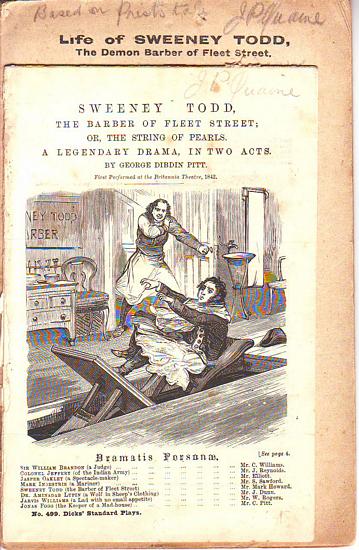
My Oxford Dictionary of National Biography article on Sweeney Todd, the legendary Demon Barber of Fleet Street, is now available as a podcast from the dictionary website. To celebrate, I've fed the article text through Wordle. The results are predictable, but might amuse.

Wordle: Sweeney Todd

Saturday morning vote-seeking

This morning I woke up to find PoliticsHome and BBC News reporting that David Cameron was in Woodstock. By the time I had reached the town centre the Conservative leader had disappeared, though television equipment and police were still in evidence. Some other parliamentary candidates were there, including a banner-bearing Stuart Macdonald, and a cheery Dawn Barnes, whom I have now informed of the existence of this blog.